Some people do make money on social media, but it rarely comes quickly or easily, and nobody can promise you an income. This blog explains the usual ways people earn from it, what it really takes in time and effort, and how to try it in a small way without risking much.
The short answer: yes, but not the way the adverts suggest
Yes, people still earn money on social media in 2026. It can look like a home baker who takes cake orders through Instagram, a guitar teacher who fills Saturday lessons with students who saw a few short videos, or a student who posts for a local hairdresser for a monthly fee. For many of them it is a bit of extra money next to a job or study, not a salary.
The stories that reach you online are mostly the success stories. Someone who earned a lot has a reason to post about it, and a course seller has a reason to show you that post. You hear far less from the much larger group who post for months and earn little or nothing, because that is not a story anyone shares or advertises.
This article gives no income figures and makes no promises. What people earn depends on the platform, the topic, the country they live in, how much time they put in and a fair amount of luck, so any number would mislead more readers than it helped. What it does give you is a clear picture of how the money is made, what the work looks like and how to try it without putting much at stake.
The common ways people earn money on social media
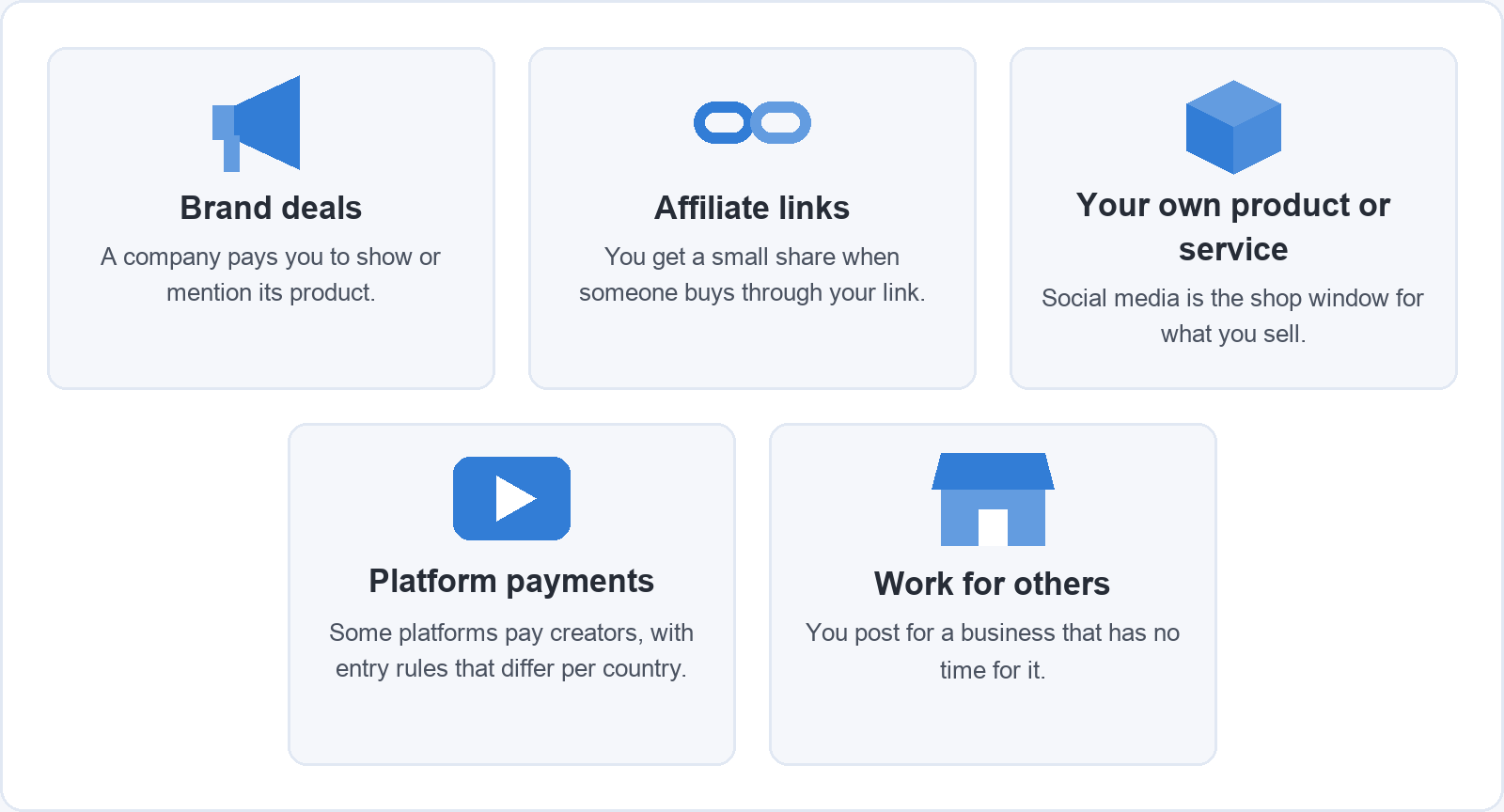
Most income from social media comes through five routes: brand deals, affiliate links, selling your own product or service, payments from the platform itself, and doing social media for someone else. Many people who earn something combine two or three of them.
Sponsored posts and brand deals
A company pays you to show or mention its product in a post, a video or a story. Sometimes the payment is money, sometimes it is the product itself. Brands look at more than follower numbers: they want to know whether your followers react to what you post and whether they are the kind of people who might buy. A gardening account with a modest, active following can be more useful to a seed company than a large account about everything. Platforms ask you to mark paid posts: YouTube, for example, has a paid promotion setting in each video’s details, and its help page reminds creators that they are also responsible for the legal requirements where they live. Check both before you post your first deal.
Affiliate links
You share a link to a product, and when someone buys through that link you get a small share of the sale. Shops and online marketplaces run affiliate programmes that anyone can join, often with conditions about where and how you share the link. The share per sale is usually small, so affiliate income tends to grow only when many people trust your recommendations. It works best when you link to things you actually use and would recommend anyway, such as the camera you film with or the book that taught you to knit.
Selling your own product or service
Here social media is your shop window and the money comes from what you sell: handmade items, prints, lessons, coaching, repairs, a home-cooked meal service. This is often the most reliable route for a beginner, because you do not need a large following. Twenty people who live nearby and want your cakes are worth more than two thousand strangers who scroll past them. If what you have to offer is knowledge, you can also turn it into an online course, and our guide on where to sell your online course compares the places to do that.
Payments from the platform itself
Some platforms pay creators a share of advertising income or a fee based on views. These programmes have entry requirements, and they are not available everywhere. YouTube, for example, asks for 1,000 subscribers plus either 4,000 watch hours in the past 12 months or 10 million Shorts views in the past 90 days, and you have to live in a country or region where its Partner Program is available. Not every platform offers payments like this, the rules differ per country and they change often, so read the platform’s own help pages rather than a video about them. For a beginner, platform payments usually come last, after a following has already been built.
Doing social media for others
Plenty of local businesses know they should post more and have no time to do it: a bakery, a garage, a physiotherapy practice, a small hotel. You can offer to plan, photograph and post for them, for an agreed fee each month. This is paid work rather than creator income, and it does not depend on your own follower count at all. What it does need is a clear agreement about what you deliver, when, and what happens if the business wants changes.
What it takes in time and effort
Earning from social media takes regular posting over months, a lot of trial and error, more production time than most people expect, and some admin. Here is what that work looks like in practice.
Months of posting, often before any money comes in
Followers, and the trust that makes them buy, build slowly. It is common to post regularly for months before the first brand asks about a deal or the first stranger orders something. Regular matters more than often: three posts a week that you can keep up for a year will do more than daily posts that stop after three weeks.
Learning what your followers want to see
Some posts will reach far more people than others, and it is not always clear why. The work is to look at which posts got saved, shared or commented on, make more of what worked, and try something different when a post falls flat. Most platforms have a free statistics screen that shows these numbers per post. A post that does badly tells you something about your audience, and you can use that in the next one.
Making the content itself
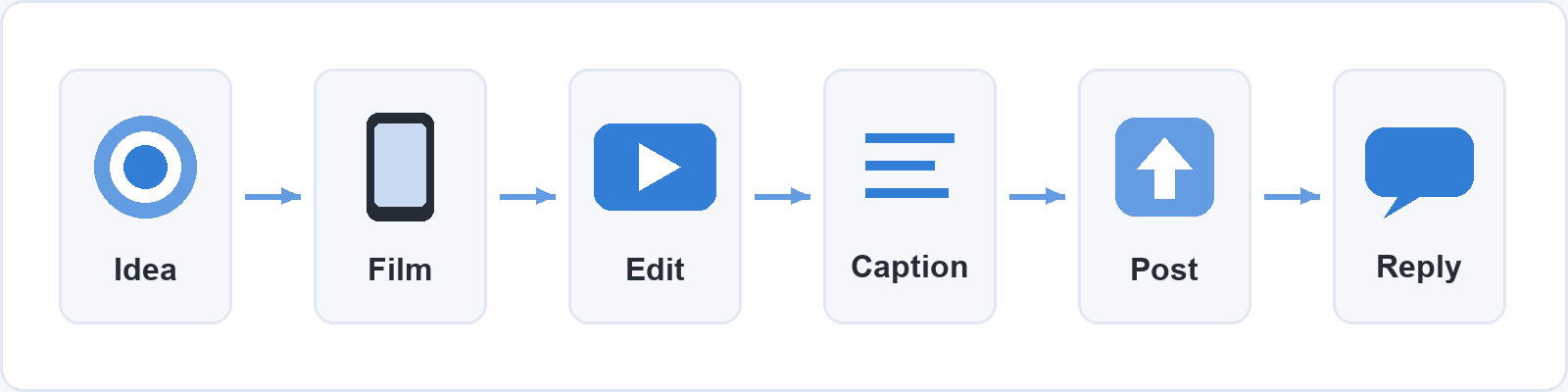
A single short video can mean choosing an idea, filming several takes, editing, writing a caption, posting and replying to comments afterwards. Photos need decent light and a tidy background. All of this takes more time than people expect when they see the finished post. A phone is usually enough equipment: our guide to better smartphone photos covers the three camera settings that make the biggest difference, and Canva handles simple graphics and text for free.
The admin that comes with it
Once money is involved, some paperwork comes with it. Brand deals need a written agreement about what you post, when, how the brand may use it and when you get paid. You need to keep track of what you earn and what you spend. And income from social media is income, so check the tax rules where you live, or ask someone who knows them, before the money adds up. Clear, polite emails make the brand side much easier; the free course Writing Effective Business Emails covers the basics in a few short lessons.
Keeping going without quick results
It can be tiring to keep posting when the numbers barely move. That is normal, not a sign you are doing it wrong, and it is the reason the plan further down starts with a small, fixed amount of time. Spending hours a day in the apps can also wear you out, and our article on using your phone less has practical ways to keep your own scrolling in check while you post.
Watch out for easy-money promises
Be most careful with anyone who promises fast or guaranteed income from social media, because nobody can control what an audience does. These are the three warning signs to look for.
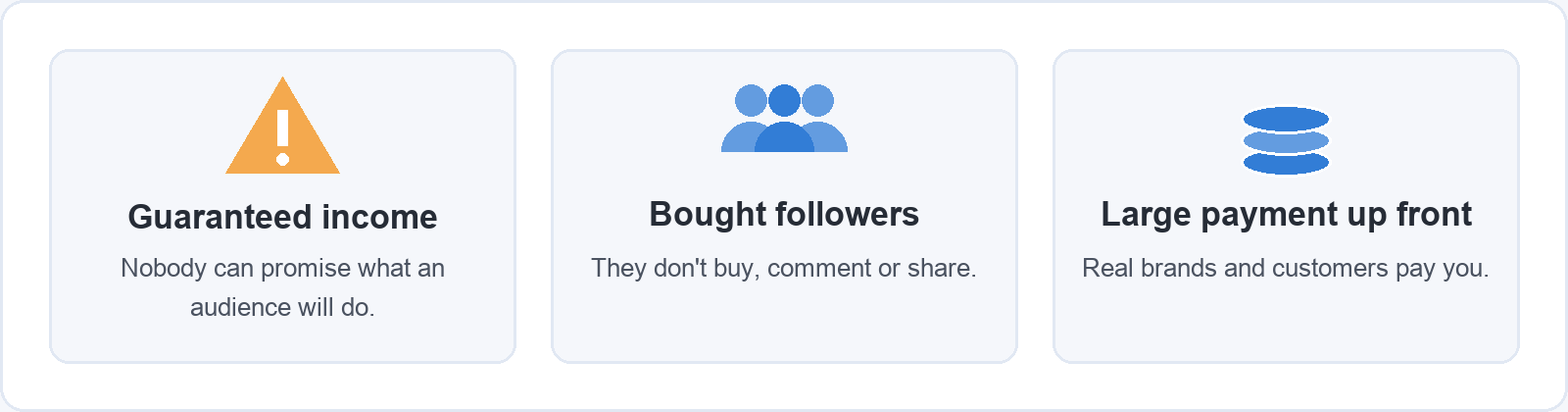
Be careful with courses, coaches or apps that promise fast or guaranteed income. A guarantee about followers or sales tells you more about the seller than about your chances. Watch for screenshots of earnings you cannot check, countdown timers on the offer and the claim that you need no time or skill. A good course teaches you a skill, such as filming, editing or writing, and is clear that the results are up to you.
Buying followers or likes might make an account look bigger, but bought followers do not buy anything, do not comment and do not share. They also make your numbers worse: a brand that looks at how many people react to your posts will see a large following with very little response. The same money spent on a clip-on microphone or a basic phone tripod does more for the quality of your posts.
If you have to pay a lot up front before you can “earn”, take a step back and think twice. That goes for expensive starter packs, paid memberships that promise access to brand deals, and schemes in which you earn mainly by recruiting other people. With real brand deals and real customers, the money flows to you, and the costs at the start are your own time and your phone.
How to make a small, sensible start
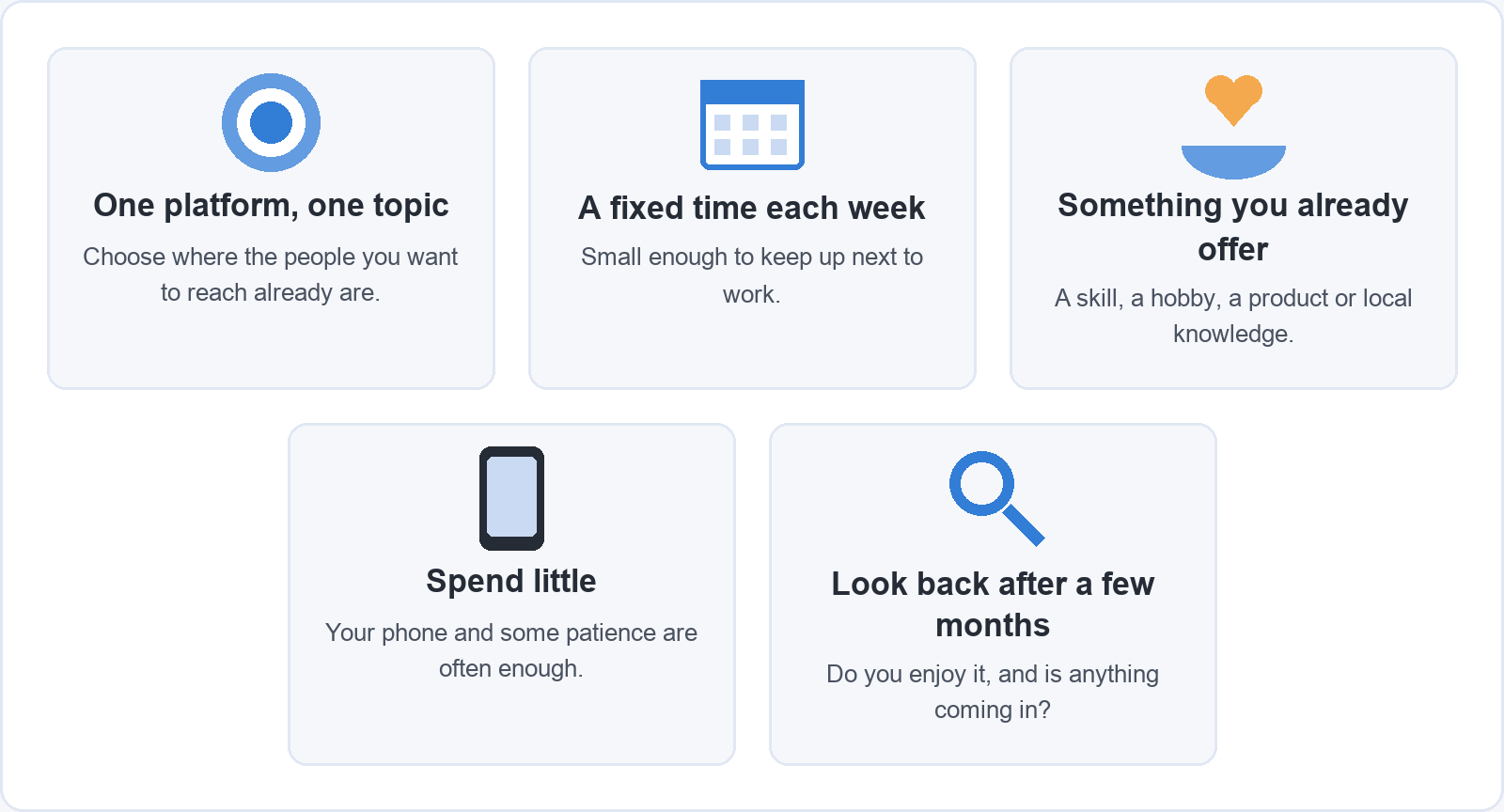
The safest way to try earning from social media is to start small: one platform, one topic, a fixed amount of time each week, something you already have to offer, and almost no money spent. After a few months you look back and decide.
Pick one platform and one topic
Pick one platform and one topic you know well or enjoy, instead of trying everything at once. Choose the platform where the people you want to reach already spend time: visual products often do well on Instagram or Pinterest, explanations and tutorials on YouTube, short lively clips on TikTok, professional services on LinkedIn. Keeping to one topic helps followers know what they get from you, and it helps you come up with ideas.
Set a fixed, small amount of time each week
Set yourself a fixed, small amount of time each week that fits next to your job or other plans, for example two evenings of an hour. Plan it like any other appointment. A small amount you can keep up for months is more useful than a burst of effort that stops when life gets busy.
Start with something you already have to offer
Start with something you already have: a skill, a hobby, a product or local knowledge. A hairdresser can post quick styling tips, a keen cook can share weeknight recipes, someone who knows their city well can post walks and cafés. If you would like to add a skill first, a short course on photography or editing can help, and plenty of introductory courses cost nothing.
Don’t spend much money at the start
Your phone and some patience are often enough to begin. Leave paid tools, lighting kits, paid advertising and courses that cost a lot until you know you enjoy this and have seen something coming in. If you later decide to buy equipment, buy the one thing that fixes the problem you keep running into, such as poor sound or dark photos.
Look back after a few months
After a few months, look back carefully: do you enjoy it, and is anything coming in? Count everything, including the small things: a first order, a brand that sent a product, a business that asked about your rates. Then decide whether to carry on, change the platform or the topic, or stop and keep what you learned.
Is it worth it for you?
Social media can work as a side project if you enjoy making content and accept that the outcome is uncertain. It suits people who would post about their subject anyway, and who see any income as a bonus at first rather than something their budget depends on. It suits people less well if they need a reliable extra income soon.
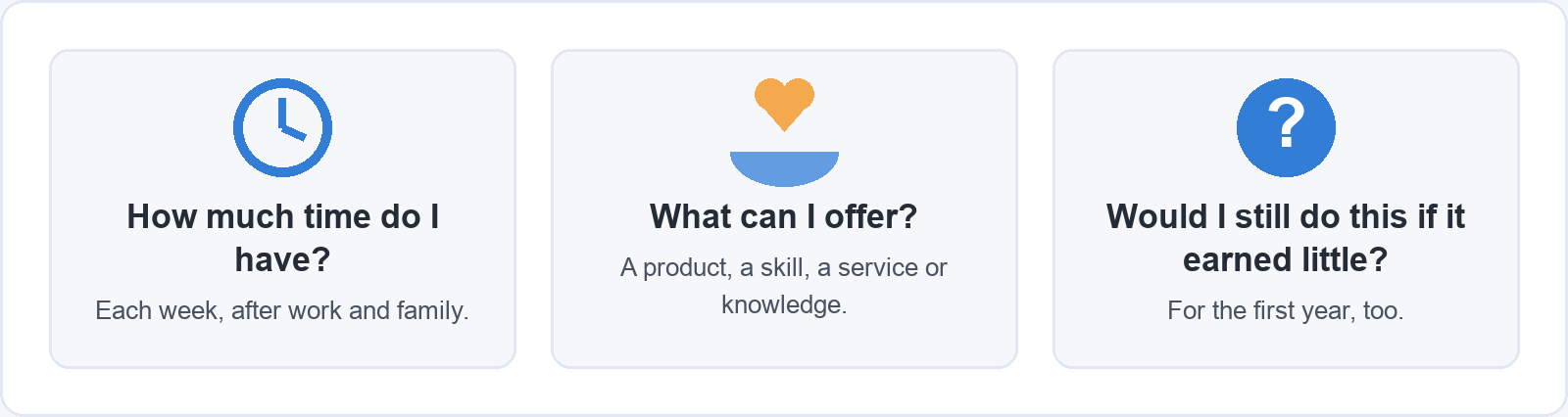
Three questions help you decide. How much time do I really have each week, after work, family and rest? What can I offer that someone would value: a product, a skill, a service or knowledge of a place or a subject? And would I still do this if it earned little or nothing for the first year?
If your answers point to yes, start with the skills that make posting easier. The free courses on Soofos let you learn things like photography, Photoshop or Excel at no cost, so the first step in your side project costs you time rather than money.