
Hard skills get you noticed and soft skills help you do the job well with other people. A hard skill is something you can learn, test and show, such as building a spreadsheet or speaking Spanish. A soft skill is how you work with others and handle your own work, such as listening, explaining and staying calm when people disagree. This article explains the difference with everyday examples, shows why employers look at both, and gives you a simple way to practise one soft skill: listening.
What hard skills are
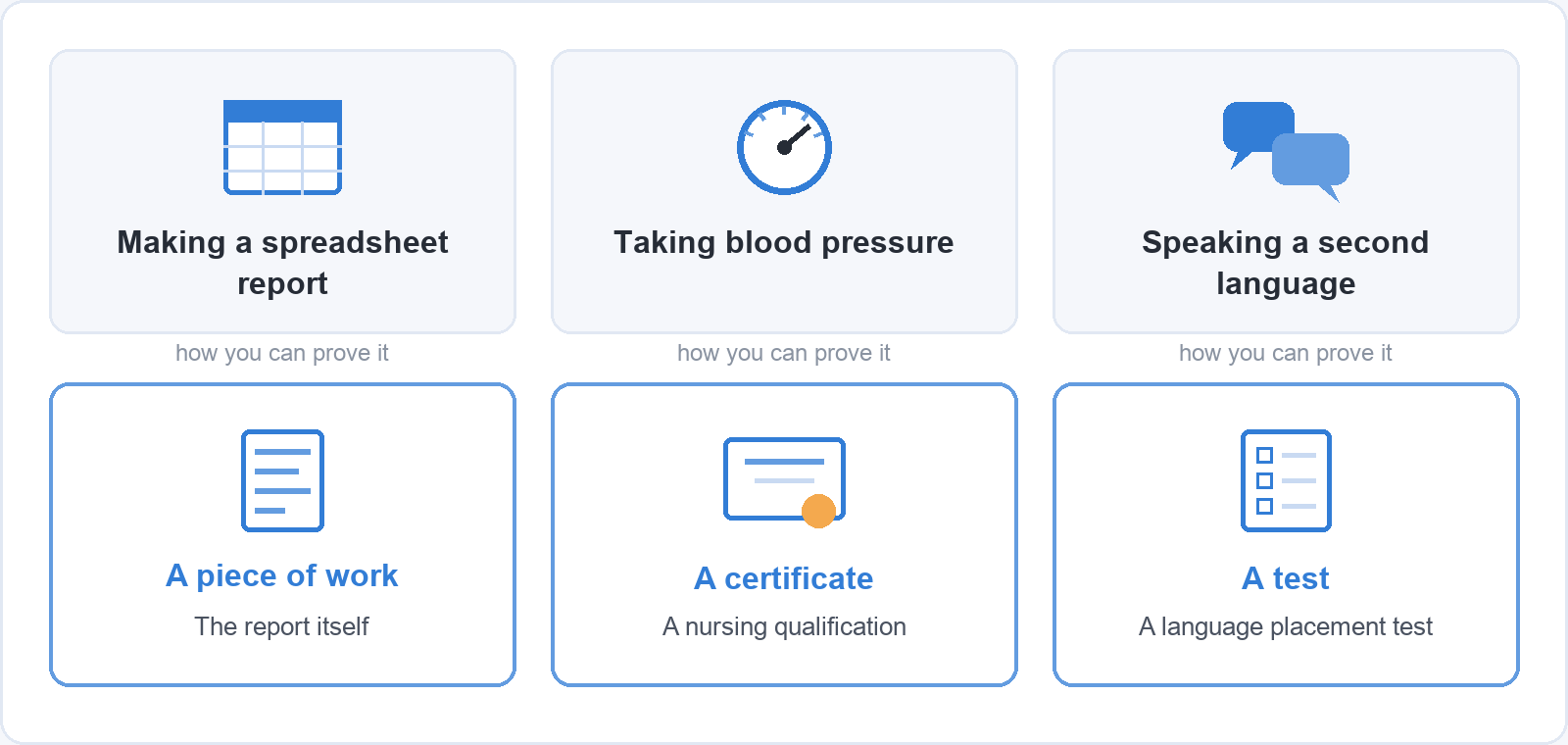
Hard skills are things you can learn, test and often show on paper: using a spreadsheet, writing code, speaking a second language, driving a forklift, reading an X-ray. They have clear steps and a clear result, so someone else can check whether you have them, for example by asking you to build a pivot table from a list of sales.
Every job has its own set. A nurse takes blood pressure, sets up a drip and records the readings correctly. A bookkeeper reconciles a bank account. A chef times six dishes so they leave the kitchen together. An office worker turns a month of sales figures into a report the manager can read in two minutes, which takes knowing the spreadsheet (our guide to what Excel does is a good start) and knowing how to lay out a page. A developer reads an error message and finds the line that caused it, which is the kind of skill our article on ways to learn to code is about.
You can usually prove a hard skill in one of three ways. A certificate or diploma shows you finished a course or passed an exam. A test shows it on the spot, like a typing test, a language placement test or a coding exercise in an interview. A piece of work shows it best of all: the report you wrote, the website you built, the photos you took. That is also why hard skills are the easiest part of a CV to write.
What soft skills are
Soft skills are about how you work with other people and how you handle your own work. Listening well, explaining things clearly, staying calm in a disagreement, giving feedback without hurting someone, planning your week so the important task gets done first: all of these are soft skills. Other names for them are people skills, interpersonal skills or transferable skills.
Picture two meetings about the same problem. In the first, people start answering before the speaker has finished, two of them argue about something nobody actually said, and the meeting ends with the question asked again by email. In the second, one colleague listens to the whole explanation, says “so the delivery is late because the supplier changed the date, and you need to know if we can move the launch”, and gets a yes within a minute. Because one person listened to the end before answering, the second meeting is shorter and nobody has to repeat themselves.
Soft skills are harder to measure than hard skills. There is no certificate that proves you listen well, and a manager rarely writes “explained things clearly” in a review even when it saved the team a week. Because nobody tests them, people often forget to work on them, and many assume they are part of your personality. Most of them are habits, and habits can be practised like any other skill, which is what the last part of this article does with listening.
How the two differ, side by side
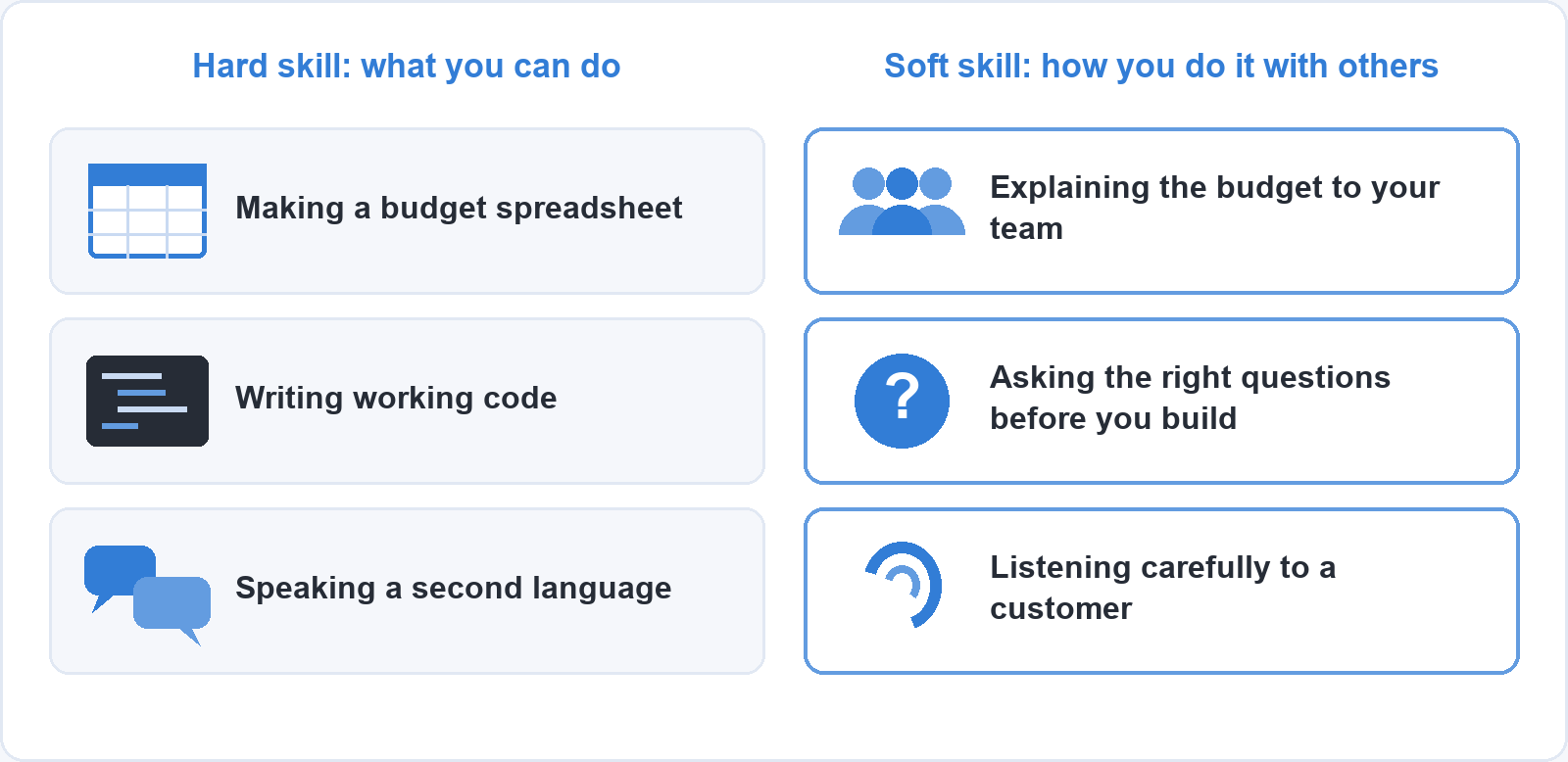
The simplest way to tell them apart: hard skills are what you can do, and soft skills are how you do it, together with others. Making a spreadsheet is a hard skill. Explaining that spreadsheet to your team so they use it correctly is a soft skill.
Hard skills often belong to one job or one tool. Knowing how to take blood pressure helps a nurse and not an accountant, and a design program you mastered ten years ago may no longer be in use. Soft skills come with you from job to job. A good listener is a good listener in a hospital, a shop, a school and an office, and the skill does not go out of date when the software changes.
Here are three pairs from ordinary work:
| Hard skill: what you can do | Soft skill: how you do it with others |
|---|---|
| — | — |
| Making a budget spreadsheet | Explaining the budget to your team so they can use it |
| Writing working code | Asking a colleague the right questions before you build anything |
| Speaking a second language | Listening carefully to a customer who speaks it differently from you |
The line between them is not always sharp. Writing a clear email needs grammar and spelling, which you can learn and test, and it also needs a sense of what the reader already knows and how they will feel reading it. Selling, teaching and managing projects are the same: part method, part people. Most real tasks need a bit of both, so it helps to treat the two words as a way of looking at a task, not as two boxes every skill has to fit into.
Why employers look at both
Hard skills often help you get through the first selection for a job. A job advert for a bookkeeper asks for accounting software, a nursing vacancy asks for a registration, a developer role names a programming language. Whoever reads the applications, a person or a piece of software, often checks for those first, because they are easy to compare across a pile of CVs.
Soft skills show up in the interview and in daily work. In the interview they hear how you answer: whether you listen to the whole question, whether you ask something back when a question is unclear, whether you can explain a past project to someone who was not there. After you start, your colleagues notice the same things every day, in how you run a meeting, how you handle a mistake and whether people come to you with problems.
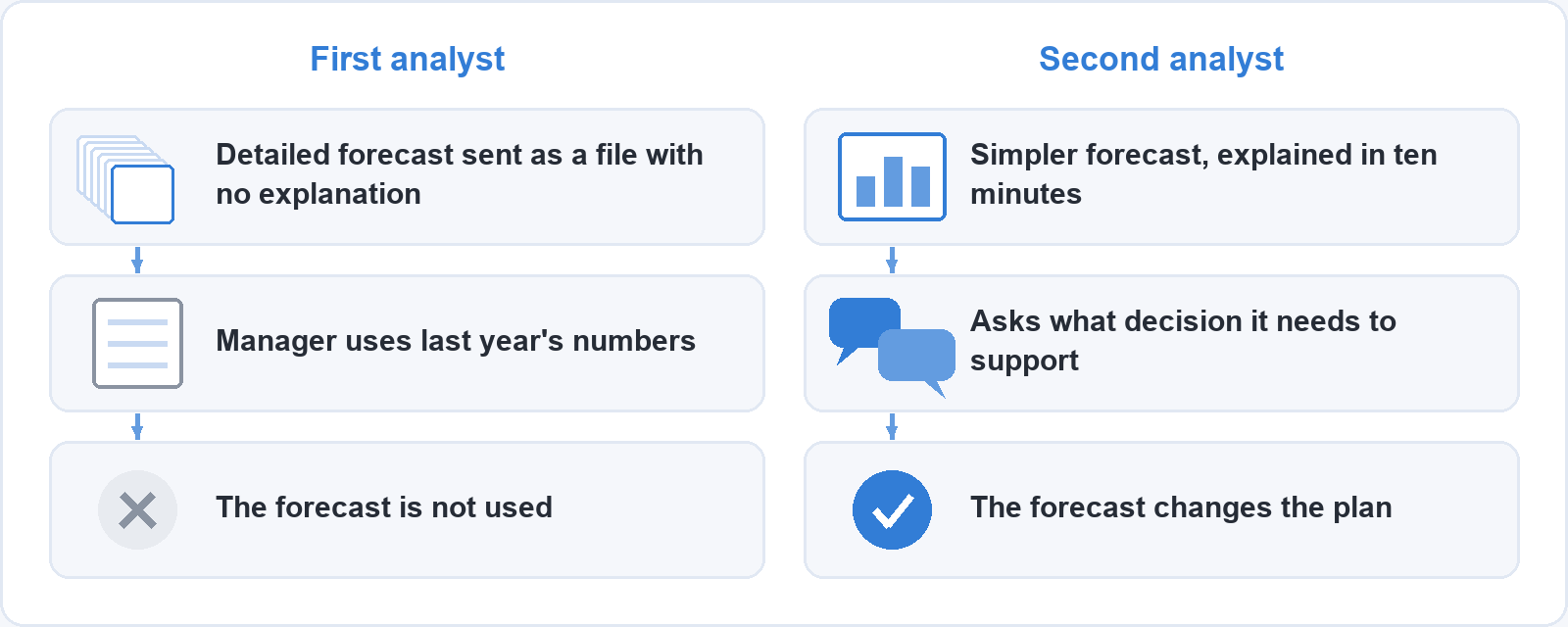
A strong hard skill is worth less if nobody understands your work or wants to work with you. Take an analyst who builds an excellent forecast but sends it as a file of forty tabs with no explanation. The manager does not have time to work it out, uses last year’s numbers instead, and the forecast is never used. A second analyst builds a simpler forecast, walks the manager through it in ten minutes and asks what decision it needs to support. The second forecast changes the plan. Both analysts have the same hard skill, and what happened to their work depended on how they explained it and what they asked.
Which skill should you work on next?
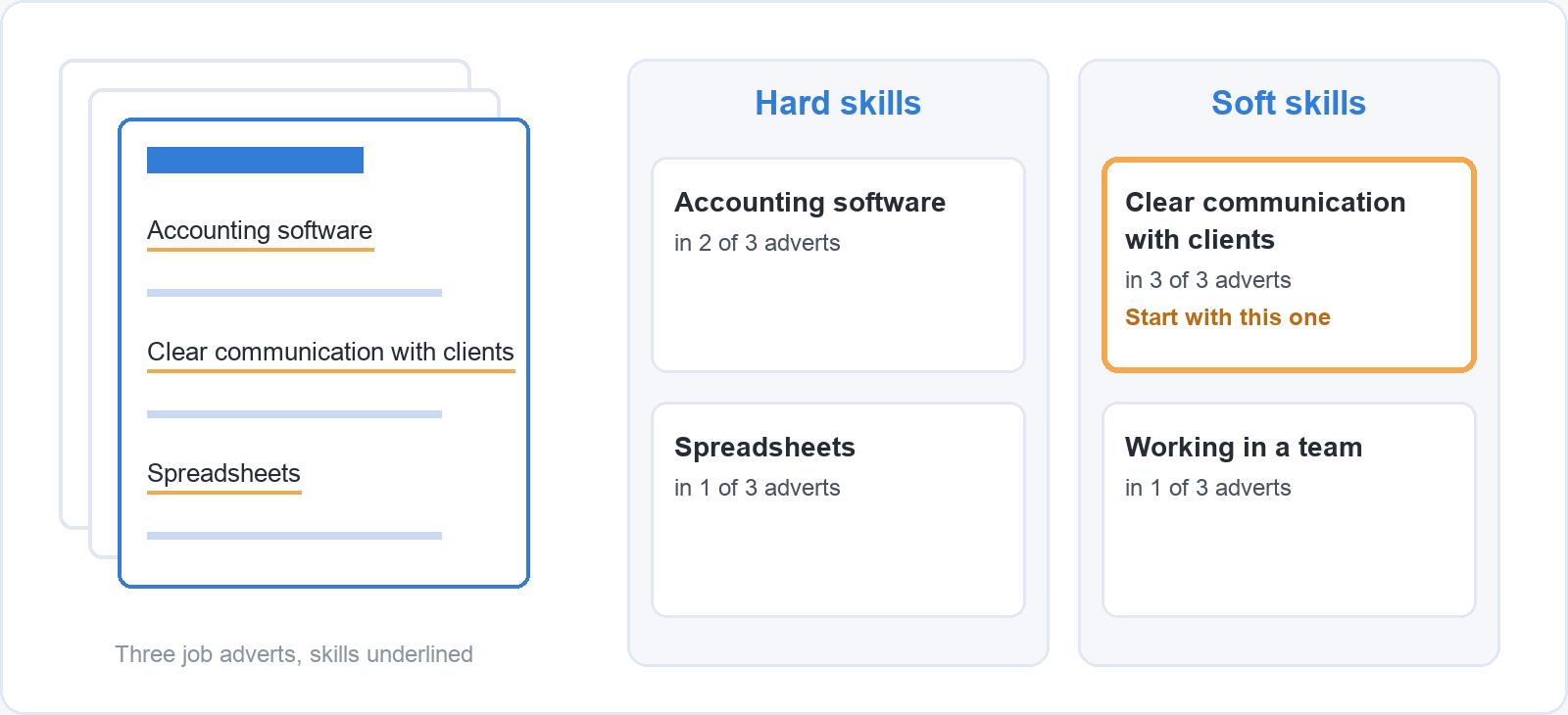
The quickest way to choose is to look at what your work actually asks of you. If you are looking for a job, take three job adverts you would like to apply for and underline every skill they mention. If you already work, look back at your last week and note the moments that went badly or took longer than they should have. Then sort what you found into two columns, hard skills and soft skills, and see which ones come back more than once.
A repeated skill is a better choice than an impressive one. If three adverts ask for “clear communication with clients”, that matters more for you right now than a skill one advert mentions in passing. If three of your bad moments last week started with a misunderstanding, listening is a better project than learning a new tool.
Pick one skill to start with, not five at once. Working on one thing gives you a fair chance to notice whether it improves, and it fits next to a full week. When the first one feels routine, move on to the next skill on your list.
If you are not sure, ask a colleague or a friend which skill they would pick for you. People who work with you see things you cannot see from the inside, such as how often you interrupt, or how clearly you explain a plan. Ask for one skill, not a list, and thank them whatever they say.
How to practise listening, step by step
Listening is a soft skill you can practise in every conversation, starting today. You do not need a special setting or a partner who knows you are practising. The three steps below work in a meeting, on a phone call, with a customer or at the dinner table, and each one takes a few seconds.
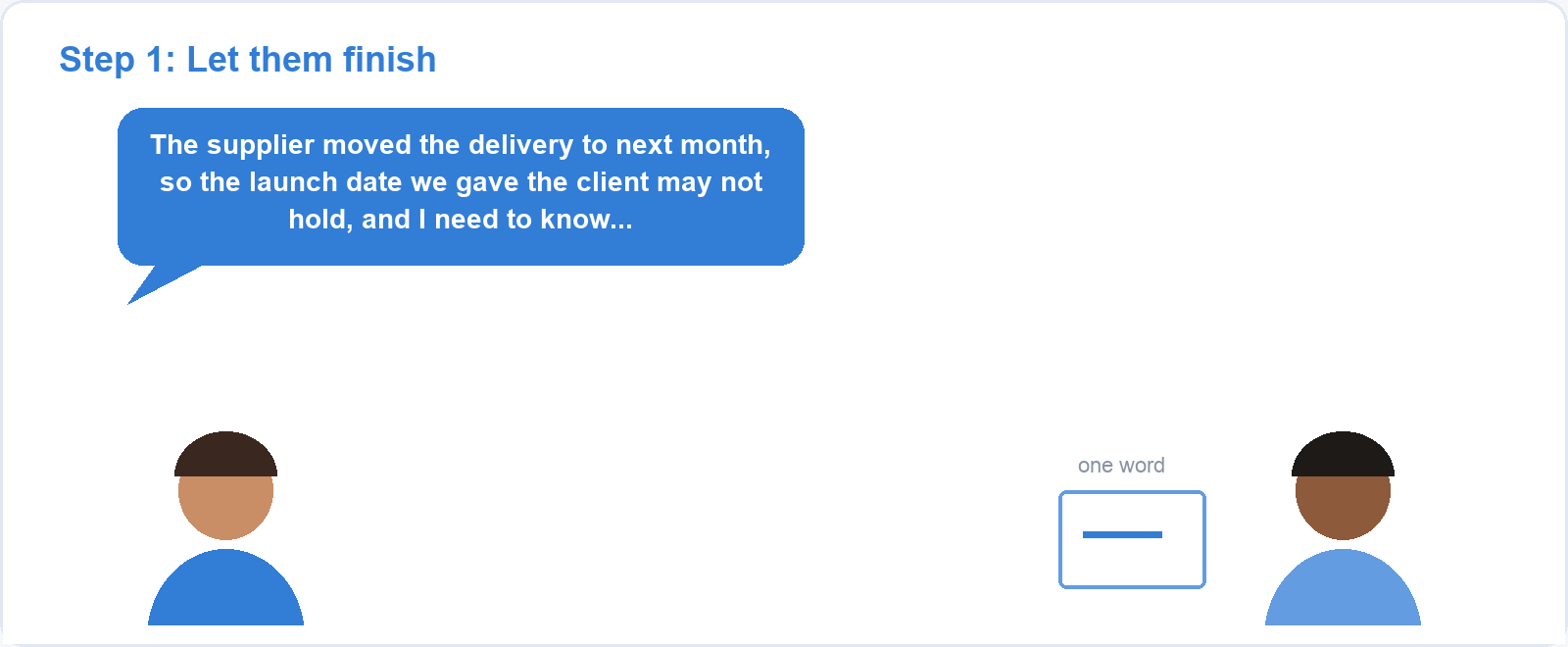
Step 1: Let the other person finish
Let the other person finish before you think of your answer. It is easy to start building your reply halfway through the other person’s sentence, and from that moment they are listening to themselves. When you notice you are preparing an answer, put it aside and go back to what the other person is saying. Wait until they have actually stopped. If you are afraid you will forget your point, write one word on a notepad and keep listening.
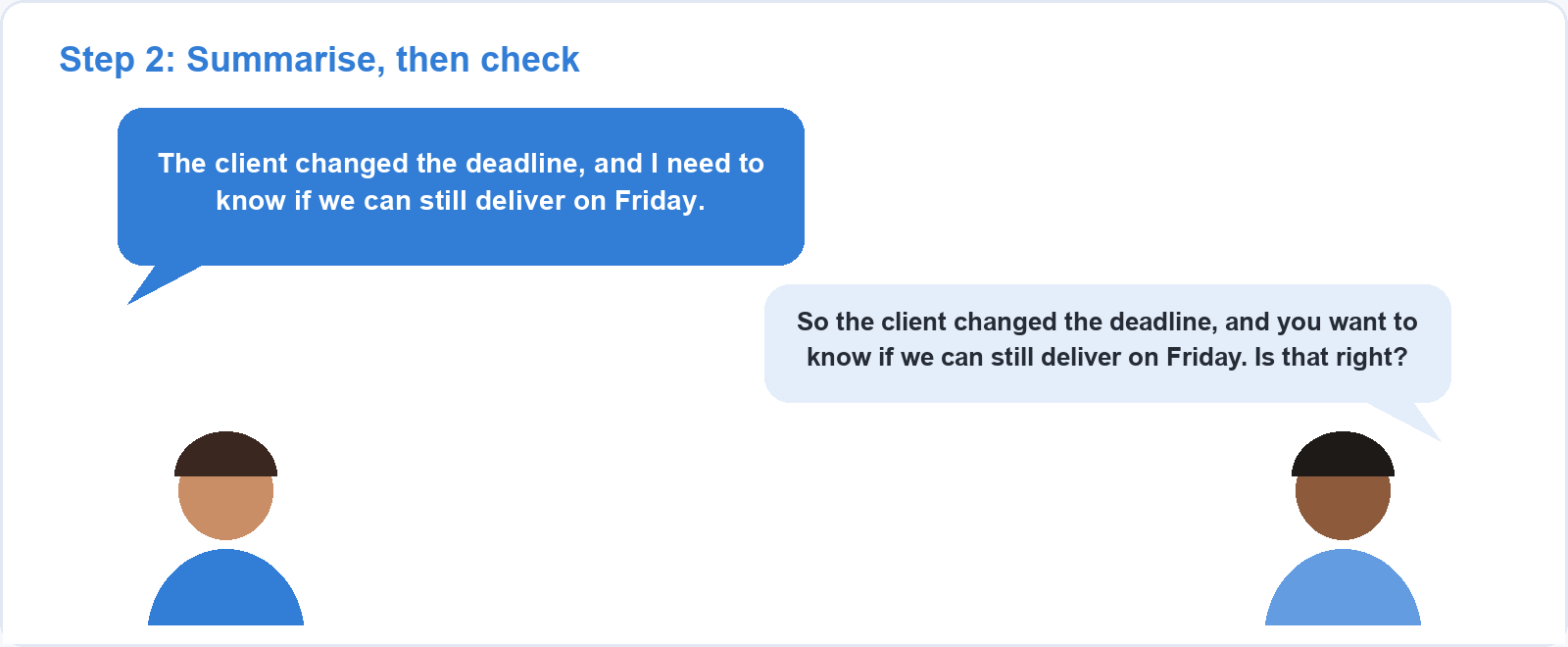
Step 2: Summarise what you heard, then check
Summarise in your own words what you heard, then check if you got it right. Keep it short: “So the main problem is that the client changed the deadline, and you want to know if we can still deliver on Friday. Is that right?” The other person can now correct you before you act on the wrong idea, and they know they were heard. If they say “not quite”, that is useful too, because you just caught a misunderstanding that would otherwise have cost you time later.
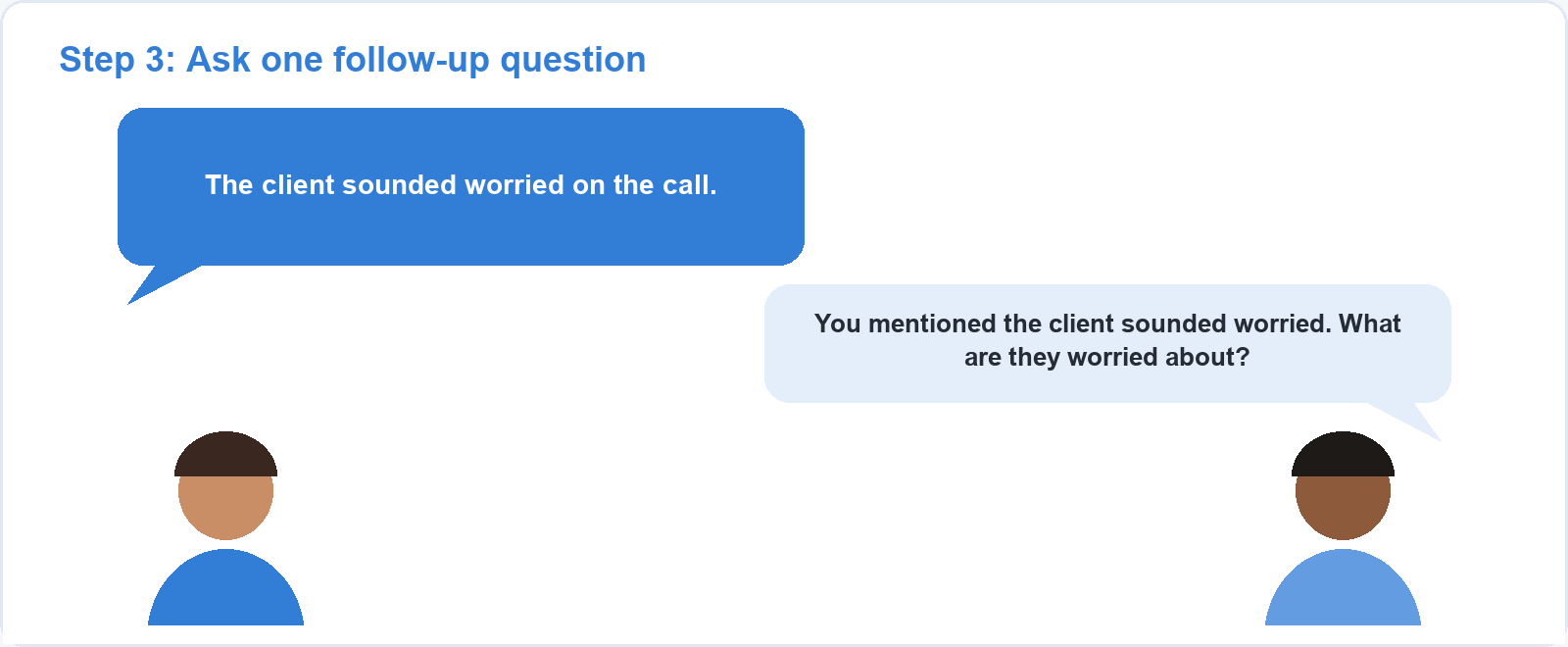
Step 3: Ask one follow-up question
Ask one follow-up question that shows you were listening. A good follow-up uses something the other person said: “You mentioned the client sounded worried. What are they worried about?” It shows that you heard the detail, and it often brings out the information that matters most. One question at a time is enough; several in a row can leave the other person feeling questioned rather than heard.
These three steps are the start. If you want to go further, the course Active Listening With Empathy: Essential Soft Skills walks you through this with a real teacher. Alex Genadinik takes you through 50 short lessons in eight sections, from the basics of active listening and reading non-verbal signals to giving and taking feedback, with listening exercises that come with worked answers.
Both matter, so start small
Hard skills and soft skills work best together. The hard skill lets you do the task, and the soft skill makes sure the task is understood, used and done with other people rather than around them. Most jobs need a few of each, and the mix changes as your work changes.
You do not need a big plan to get better at either. Pick one small step for this week, such as summarising what you heard once in your next meeting and asking whether you got it right. Notice how the other person reacts, and try it again the next day.
No single skill guarantees a job or a pay rise. Regular practice does make conversations easier, and it makes your work easier for other people to understand and use. If listening is the skill you picked, Active Listening With Empathy is a good next step: the first two lessons are free to watch, no account needed.