
When the teaching is the same, people learn about as much online as they do in a classroom. That is the finding of two widely cited meta-analyses of controlled studies, one covering 50 comparisons for the US Department of Education and one covering 168 courses and more than 19,000 learners. Where the two formats really differ is in who finishes, in which kinds of skill they suit, and in how much work went into building the course for the format it is delivered in.
Most of the pages that rank for this question give a list of pros and cons: online is flexible, the classroom is social, online needs self-discipline. All of that is true and none of it tells you which to choose. This article goes through what the research measured, why so many people still believe the classroom wins, where online learning does fall short, and how to pick a format for yourself or for a team.
Do people learn as much online as in a classroom?
Yes, on average, once you compare like with like. The best-known evidence is a meta-analysis by Barbara Means and colleagues at SRI International for the US Department of Education, revised in September 2010. It screened 1,132 abstracts and kept only studies that used an experimental or quasi-experimental design and measured learning objectively. Forty-five of them, published between 1996 and 2008, contained enough data to produce 50 comparisons between online or blended conditions and face-to-face teaching. Most of the learners were college students, graduate students or adults in professional training, and the most common subject was medicine and health care.
Across all 50 comparisons, the online conditions came out slightly ahead, with an average effect size of +0.20. An effect size here is the difference between the two groups’ average scores divided by the spread of the scores, and the convention the report itself cites calls 0.20 small. The headline number hides the more useful result. When the researchers split the comparisons, purely online courses against purely face-to-face ones produced an average of +0.05, which was not statistically significant: the report calls the outcomes of the two groups “statistically equivalent”. The advantage came almost entirely from blended courses, which mixed online and face-to-face elements and averaged +0.35.
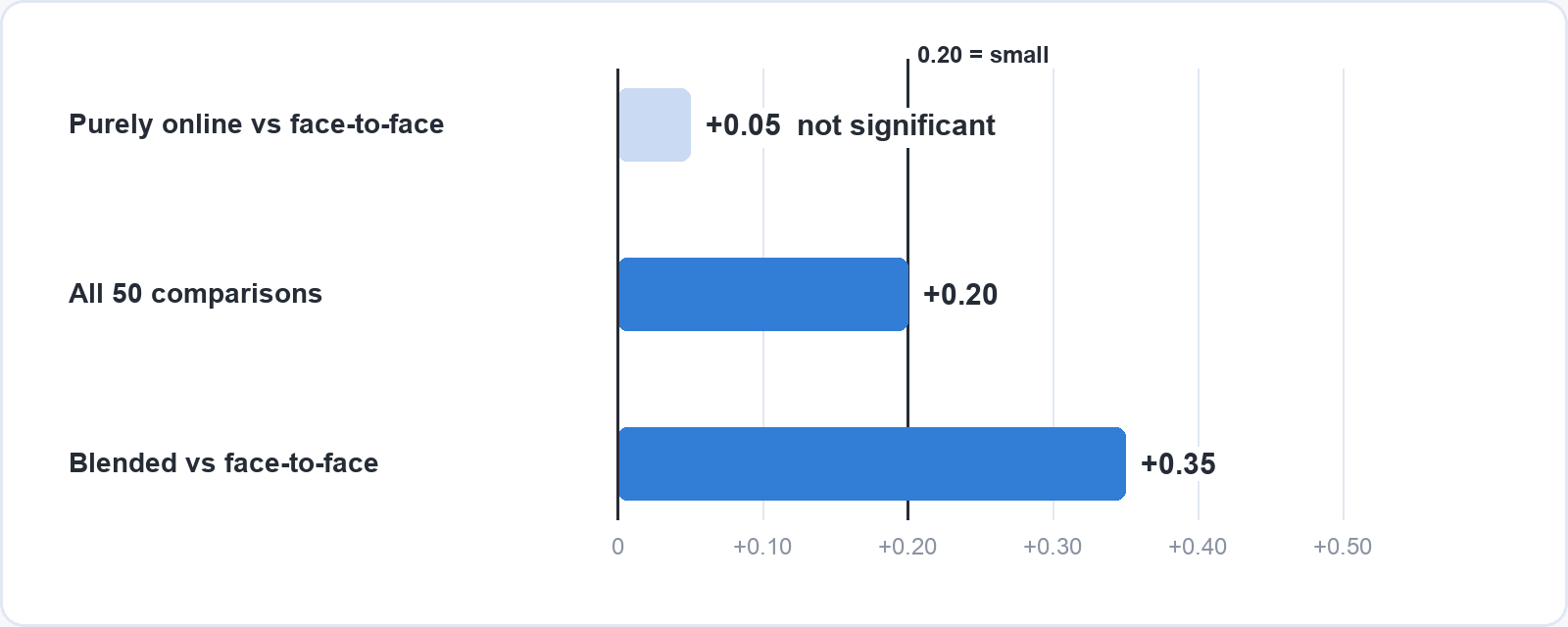
The authors are careful about what that blended advantage means. Many of the studies did not hold the curriculum, the teaching approach or the learning time constant between the two groups, and the report says the advantage “is not necessarily rooted in the media used per se and may reflect differences in content, pedagogy and learning time”. Their own numbers support the caution. In studies where the online learners spent more time on the material than the classroom group, the average effect was +0.45; where the classroom group had as much time or more, it was +0.18.
A second meta-analysis, by Traci Sitzmann, Kurt Kraiger, David Stewart and Robert Wisher in Personnel Psychology (2006), looked at training rather than school. It drew on 96 research reports covering 19,331 people in 168 courses, most of them undergraduates and the rest graduate students and employees. Web-based instruction was 6% more effective than classroom instruction for declarative knowledge (facts, concepts, knowing what), the two were equally effective for procedural knowledge (being able to carry out the steps), and trainees were equally satisfied with both. When the web-based and classroom versions used the same instructional methods, the difference on declarative knowledge disappeared.
Both reviews end in the same place as an argument the educational psychologist Richard Clark made in 1983: the medium carries the instruction but does not change how much people learn from it, in the way a delivery truck does not change the nutritional value of the groceries it brings. What moves the result is what happens inside the course: how much practice there is, whether learners get feedback, how long they spend on it and whether someone is directing the work.
Why do so many people still believe the classroom wins?
Two things shape most people’s view, and neither of them contradicts the controlled studies. The first is that a large share of adults formed their opinion of online learning in 2020 and 2021, when schools and universities moved online in days. On 27 March 2020, five instructional technology academics led by Charles Hodges gave this a name in an EDUCAUSE Review article: emergency remote teaching, “a temporary shift of instructional delivery to an alternate delivery mode due to crisis circumstances”. They pointed out that the typical planning, preparation and development time for a fully online university course is six to nine months before it is delivered, and that teachers are usually more comfortable teaching online by the second or third run of a course. The studies in the Means review were planned comparisons run long before the pandemic, most of them published in 2004 or later, rather than lectures moved onto a video call within a week.
The second is that in ordinary enrolment data, without random assignment, online students often do worse. Di Xu and Shanna Jaggars at the Community College Research Center followed more than 40,000 community and technical college students in Washington State through nearly 500,000 courses and found that all types of students in the study “suffered decrements in performance” in their online courses, measured by whether they persisted and the grades they earned. The gaps were largest for male students, younger students, Black students and students with lower grade averages. This is observational data from one US state’s colleges, so it cannot separate the format from the way those particular online courses were built and supported, but it is a real result and a fair warning. Online courses as many institutions actually run them leave more of the work of keeping going to the learner, and the learners with the least support pay for that most.
Where does online learning fall short?
The clearest weakness of online learning is completion, especially for courses that are free and open to anyone. Justin Reich and José Ruipérez-Valiente analysed 565 HarvardX and MITx courses run on edX between 2012 and May 2018 for a 2019 paper in Science, and published their summary tables alongside it. In the 2017 to 2018 year, 980,589 people took part in those courses and 3.13% completed them. Among the 42,005 participants who had said in a survey that they intended to complete, 15.42% did. Among the 46,326 who paid for the verified certificate track, 46.02% did.
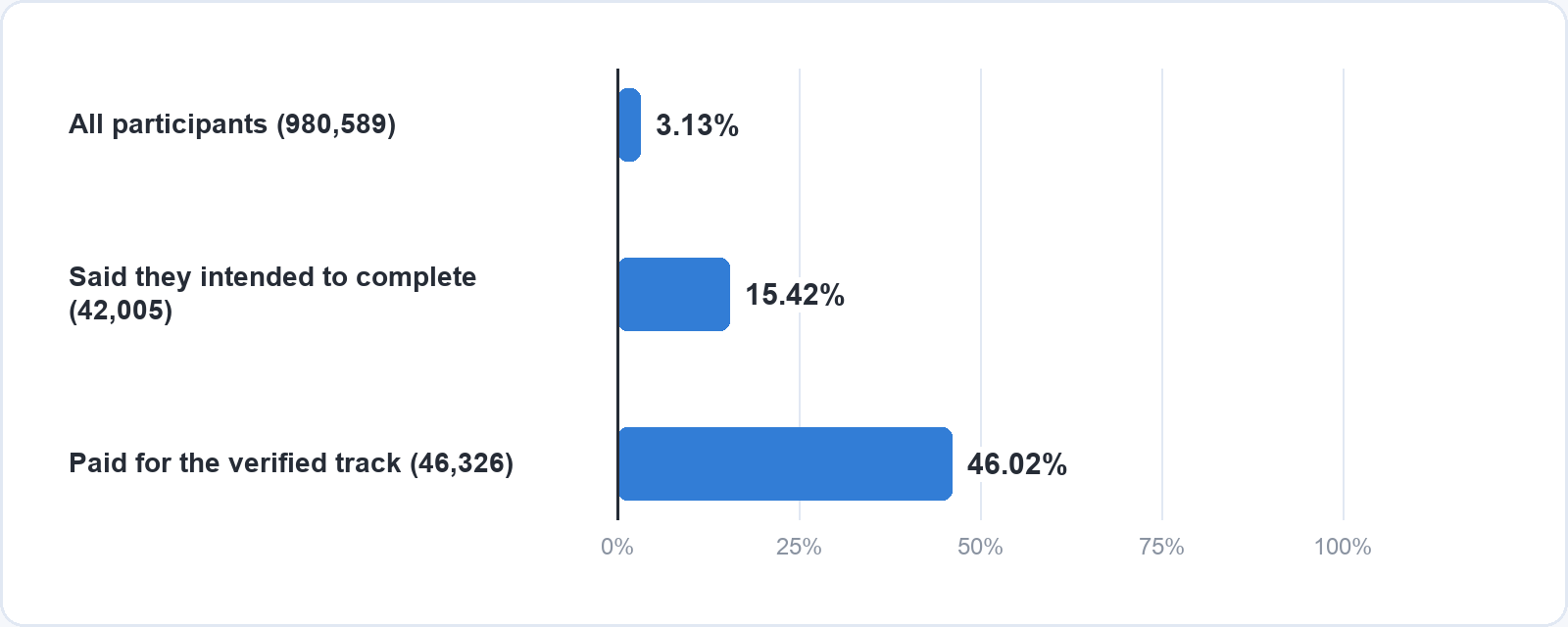
Those three groups are not comparable populations: people who pay are already more committed before they start, so the data does not show that paying makes anyone finish. What it shows is how much of online completion depends on commitment the learner brings with them. A classroom supplies a version of that commitment by default, through a fixed time, a room you have to travel to and people who notice when you are absent. An online course has to replace that with something else, such as a cohort with start and end dates, scheduled live sessions or a deadline set by an employer.
How much people learn online also depends on whether anyone else is involved. In the Means review, the type of online learning made a significant difference: online instruction that was directed by an instructor averaged +0.39 against face-to-face teaching, collaborative online learning averaged +0.25, and independent online learning, where each person works through the material alone, averaged +0.05, which was not significant.
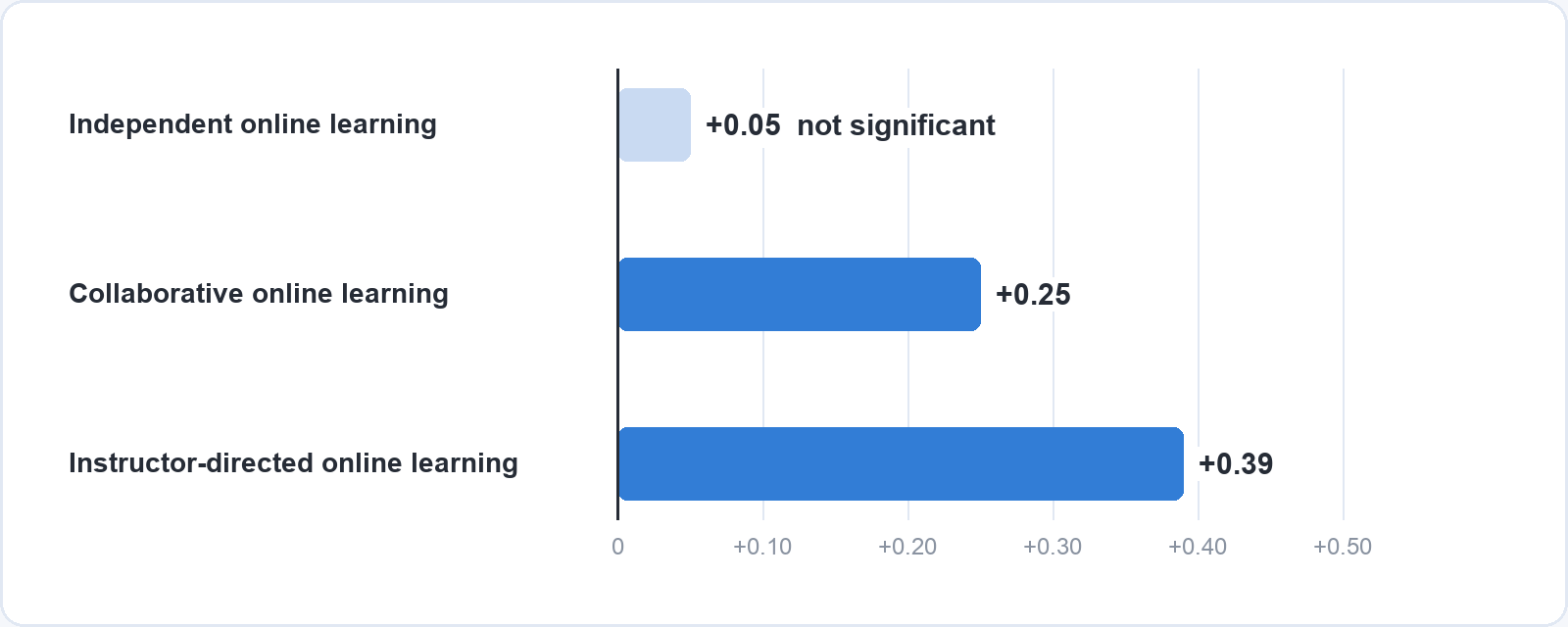
The practical reading is that the self-paced video course on its own is the weakest form of online learning for people who struggle to keep going, and the most convenient one for people who do not. Distraction at home makes this worse, which is why something as simple as where your phone sits while you study affects how far you get.
Which format suits which kind of learning?
The evidence gives no subject where one format reliably wins: the Means review found no significant differences in effectiveness linked to what was being taught. The choice turns on what the skill needs from the setting, and on what you, or the people you are choosing for, need in order to finish.
Knowledge and software skills suit online learning well. Sitzmann’s team counted procedural knowledge as the ability to perform the skills taught, measured through simulations, role plays or tests of the steps (one included study asked trainees to carry out the software tasks from the course), and the two formats did equally well. Online adds the ability to pause, rewind and return to the exact step you need, which a live demonstration cannot give you. For methods that make studying on your own more effective, the ten methods ranked by the research apply to an online course as much as to a textbook.
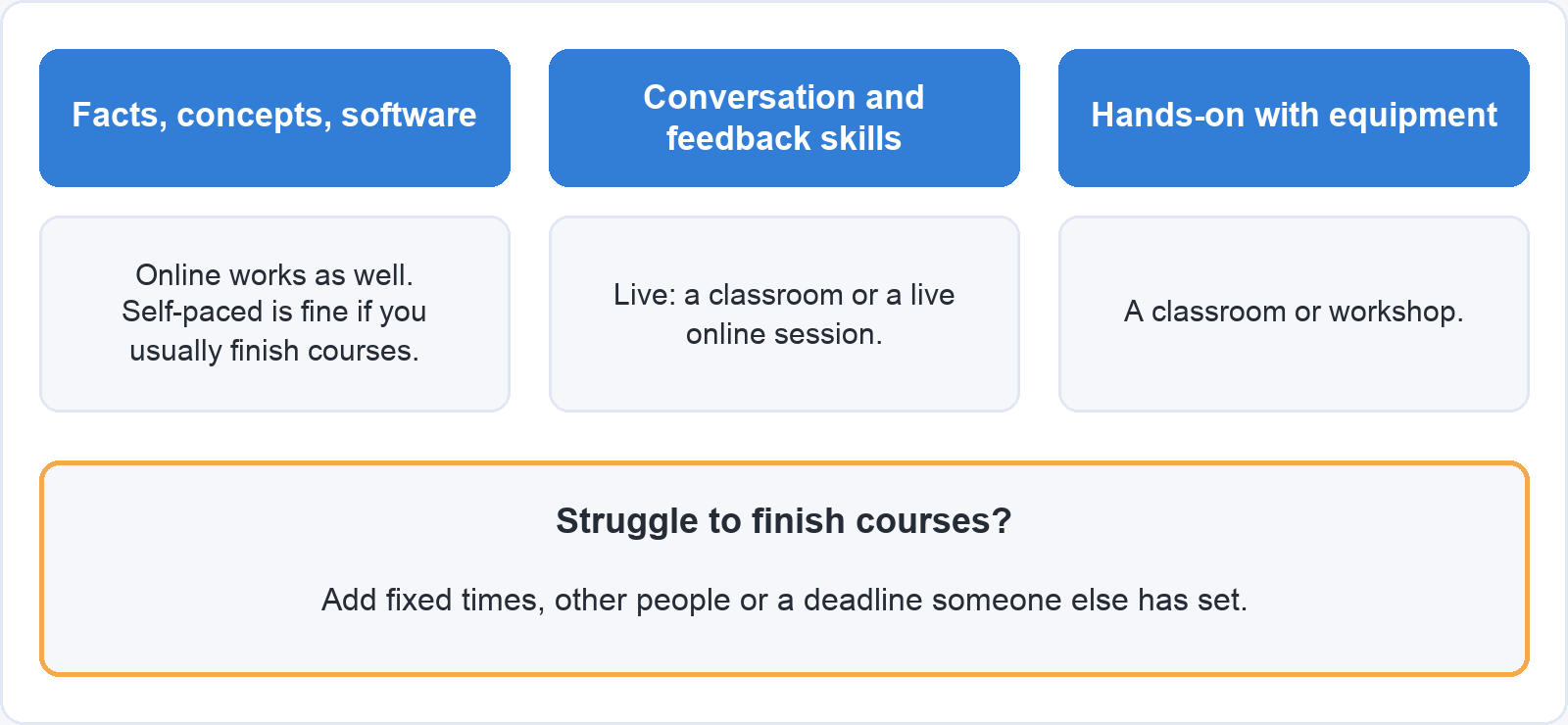
Skills that depend on someone watching you in real time need either a classroom or a live online session. Giving feedback to a colleague, handling a difficult customer, speaking to a room or working with your hands on equipment you do not have at home all improve fastest when another person sees what you did and responds. A live session on a video platform covers much of this for conversation-based skills; if you are running one yourself, the free webinar tools compared here differ mainly in how many people can speak. Physical skills that need specialist equipment or supervision for safety still need a room.
Your own situation counts as much as the skill. If you have finished self-paced courses before, online gives you the same learning with more control over time and place. If you have started several and finished none, choose a format with fixed times or other people in it, whether that is a classroom, a cohort-based online course or a self-paced course with a deadline someone else has set.
Is blended learning the best of both?
Blended learning had the largest advantage in the Means review, at +0.35 against face-to-face teaching, but the same report found that when a single study compared blended and purely online versions of a course, learning was usually about the same. Together with the time-on-task numbers, that suggests the blended courses did better mostly because they gave learners more time and more material, not because mixing the two formats is special in itself. The report’s own conclusion is that its findings “do not support simply putting an existing course online, but they do support redesigning instruction to incorporate additional learning opportunities online.”
A sensible blend gives each format the job it does best. The explanation and the demonstrations go online, where people can take them at their own pace and rewatch them. The time together, in a room or on a call, goes to practice, questions and feedback, which are the parts that need other people. A blend that streams the same lecture to some people and delivers it in person to others adds no extra practice or learning time for anyone, and extra time and material is where the review’s blended gains appear to have come from.
What this means if you choose training for a team
For an organisation, the evidence removes one worry and replaces it with another. On the evidence, online training teaches about as much as a classroom course on the same material, so the decision can rest on cost, scale and convenience. Fewer people will finish it, however, unless something takes the place of the structure a classroom provides.
The structure that does this is unglamorous: a named course, a deadline, a manager who can see progress and asks about it, and a live session for the parts that need practice with other people. If you are designing the training yourself, the steps for building a module that changes what people do cover practice and feedback in detail, and the guide to setting up an online academy covers assigning and tracking courses across a whole organisation.
Questions people ask about online and classroom learning
Is online learning harder than classroom learning?
The material is not harder, but finishing usually is. The controlled studies show the same learning in both formats when the teaching is the same, while completion data from open online courses and from community colleges both show weaker results online. In the edX data, learners who had committed in advance, by stating an intention to finish or by paying, completed at far higher rates than everyone else.
Are people less satisfied with online courses?
Not on average. In the Sitzmann meta-analysis of 168 training courses, trainees were equally satisfied with web-based and classroom instruction.
Does the research apply to children?
Only with caution. Of the 50 comparisons in the Means review, seven came from five studies with school-age learners, and the report says that caution is required before generalising its results to them. Almost all of the evidence in this article comes from adults and students in higher education.
Is a live online class the same as a classroom?
For learning, it is closer to a classroom than a self-paced course is. In the Means review, instructor-directed online instruction had the largest effect of the three types of online learning, at +0.39 against face-to-face teaching. A live online class keeps the fixed time and the teacher; the shared physical room it lacks matters mainly for hands-on skills with equipment.
Is blended learning always better?
No. Blended courses did best in the Means review, but the report attributes much of that to the extra time and material blended learners often had compared with the face-to-face group. A blend is worth its extra cost when the face-to-face time goes to practice and feedback that the online part cannot provide.
Giving online training the structure a classroom has
If you are choosing training for a team, Soofos for Business gives you that structure: you can assign a course or a learning path to one person or a whole team with an optional deadline, follow completion in real time, and add your own company courses alongside more than 600 practical courses taught by people who do the work every day.