
In 2013 five researchers went through decades of studies on ten common learning techniques and graded each one for how much it genuinely helps an ordinary learner in ordinary conditions. Two came out with a high rating: testing yourself, and spreading your study out over time. Five came out low, and that group contains highlighting, rereading and writing summaries, which between them are what most people mean when they say they have been studying.
So the quickest route to easier learning starts with subtraction. It also helps to be precise about what easier means here, because it does not mean that every session feels smooth. It means fewer hours in total, fewer repeat passes over the same pages, and less of that sinking feeling a month later when you realise the thing you learned has quietly gone.
Below is the full ranking, what each method is actually asking you to do, and what to put in place of the ones that scored badly.
Why does studying feel productive when it isn’t?
Knowing something and feeling that you know it are two different measurements, and they drift apart fastest in the hour straight after you study.
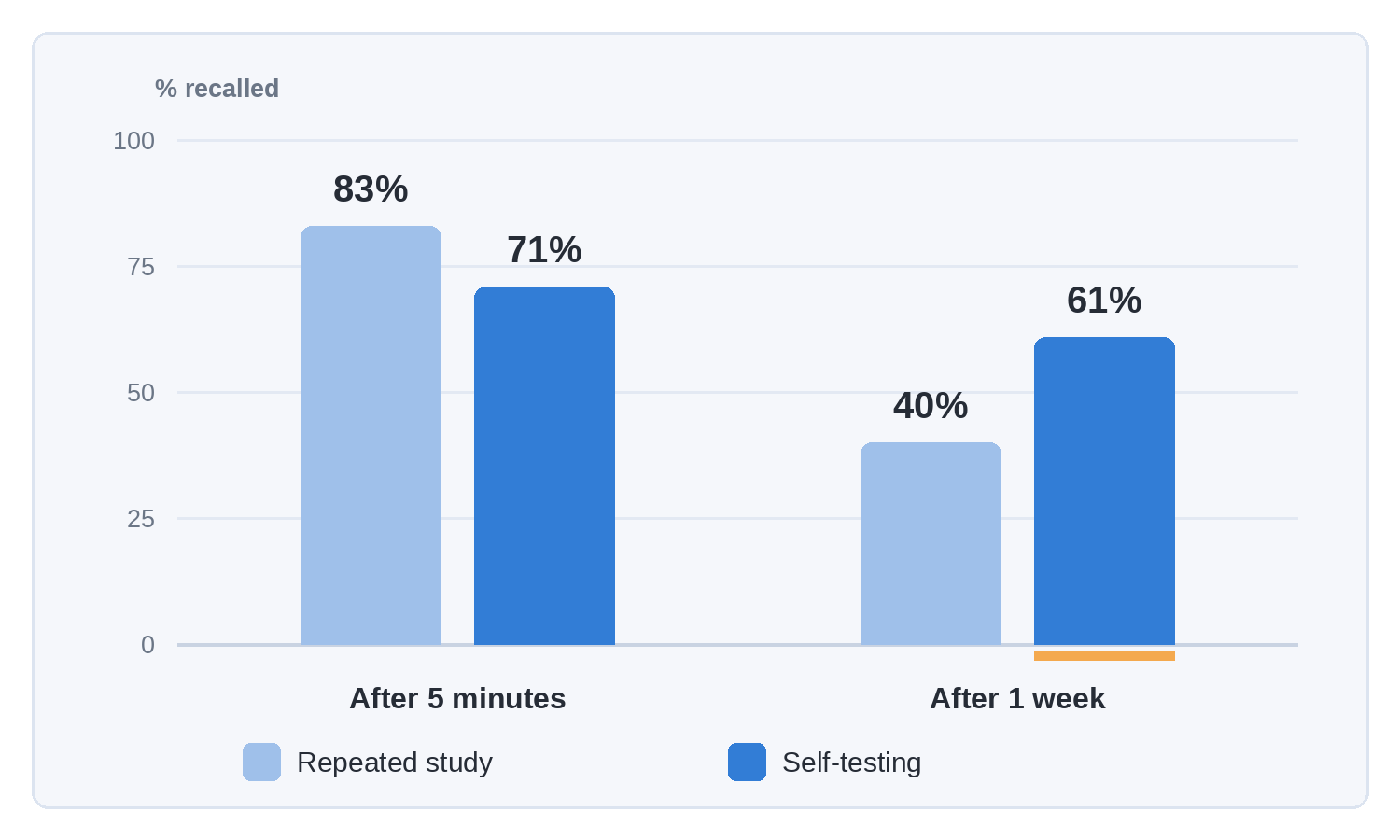
Henry Roediger and Jeffrey Karpicke ran the experiment that shows this most cleanly. Students read a short passage, then either studied it four times over, or studied it once and spent the remaining time trying to recall it from memory with the text closed. Five minutes later the repeat-studiers were ahead, 83% recall against 71%. A week later the ranking had reversed and the gap had widened. The repeat-studiers were down to 40%, and the students who had spent that time recalling were at 61%.
Rereading feels good because by the fourth pass the text is familiar, and familiarity is easy to mistake for knowledge. Recall feels bad for the opposite reason. You sit in front of a blank page, you cannot remember the second point, and the struggle reads as evidence that the session is going badly. Robert Bjork gave this class of conditions a name, desirable difficulties, meaning the things that slow your practice down and pay you back on the day you actually need the material.
The working consequence for anyone learning on their own is that you cannot use how a session felt as a measure of how it went. Getting through a chapter smoothly tells you very little about what you will still have on Thursday.
Which learning methods actually work?
Practice testing and distributed practice are the only two of the ten that earned a high rating, because they helped learners of different ages and abilities, across many kinds of material, in real classrooms as well as in the lab.
The review is Dunlosky, Rawson, Marsh, Nathan and Willingham, published in Psychological Science in the Public Interest in 2013. Here is how the ten techniques were graded.
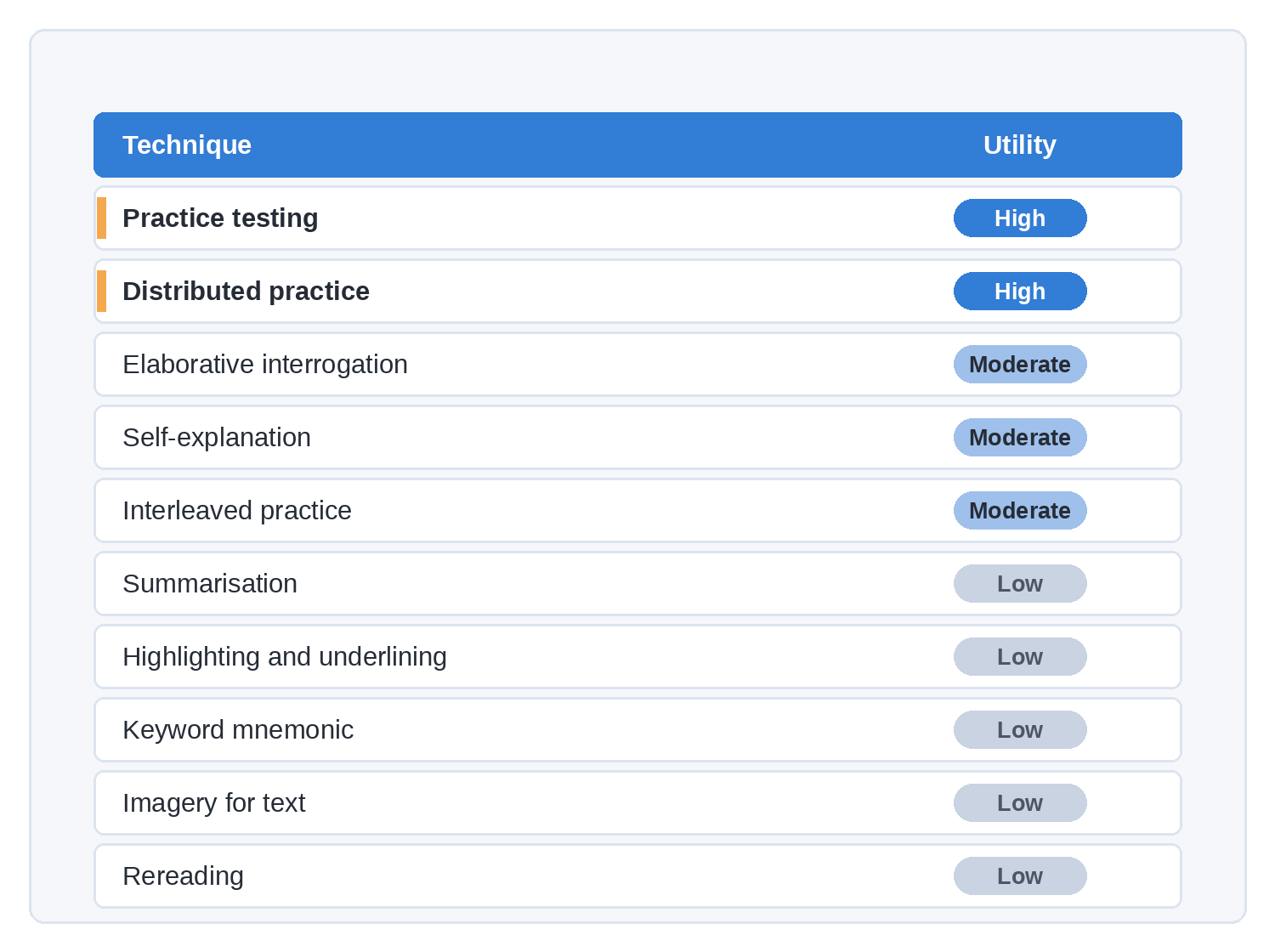
A low rating is not the same as useless. It means the evidence for a broad benefit was thin, the benefit showed up only in narrow conditions, or the technique works but people apply it badly when left to themselves. Highlighting is the clearest example. Marking a line is a decision about what matters, which is genuine work, but for most people the pen becomes the whole activity and the reading stays passive.
The five that scored high or moderate share one property. Each of them makes you produce something instead of receive something: an answer, an explanation, a reason, a guess. That is the common thread worth holding on to when you are deciding how to spend an evening.
How do you test yourself when there is no test?
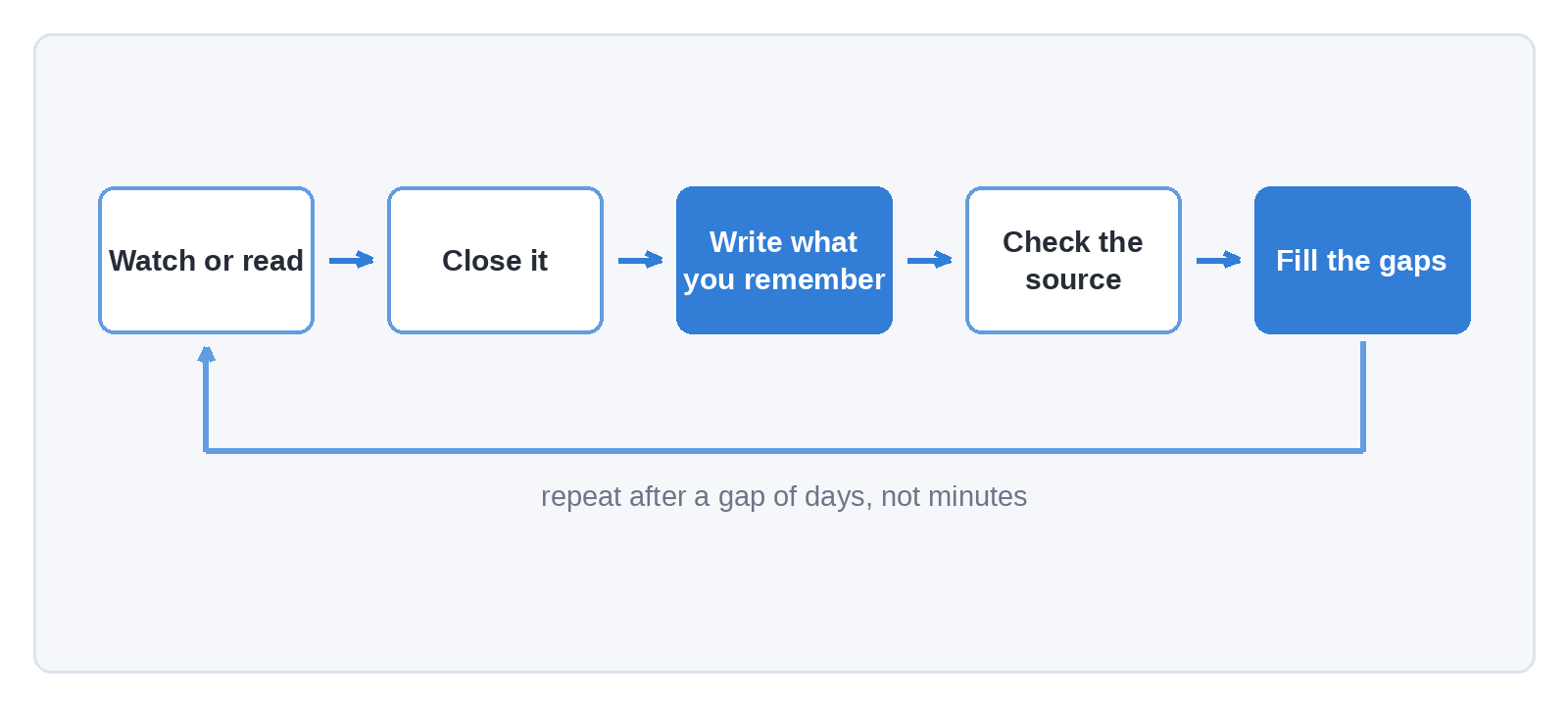
You make one, and it takes less effort than it sounds: close the material and write down everything you can remember, then open it and see what you missed.
That is the entire method. The blank page is doing the work, because retrieving a fact strengthens it far more than seeing it again does. Three variations cover most situations:
- Turn the headings into questions. Before you read a section, turn its heading into a question and try to answer it. Afterwards, answer it again from memory and compare.
- Use the quizzes the course already has. Most structured online courses include them, and skipping them to keep watching is the most common way people waste their own time. Every course on Soofos pairs its video lessons with assignments, and the free courses are a reasonable place to practise this before you commit to anything.
- Explain it to someone who does not know it. Speaking forces you to produce complete sentences, so the gaps show up immediately rather than hiding behind a phrase you half-recognise.
Doing this badly still beats not doing it. You do not need to score well, and a session where you retrieve four points out of nine has told you precisely which five to work on.
How far apart should study sessions be?
Roughly 20% of the time between now and the day you need the material, for anything you need to hold for a few weeks.
That number comes from a large study by Nicholas Cepeda and colleagues, who taught 1,354 people a set of 32 obscure trivia facts and then varied two things independently: the gap between the first and second study session, and how long after that the final test came. The pattern held across every combination. Performance rose as the gap grew, peaked, then slowly fell away again, and the peak sat at about a fifth of the total delay for delays of a few weeks, dropping to nearer 5% when the test was a year away.
In practice that gives you a usable rule rather than an exact schedule.
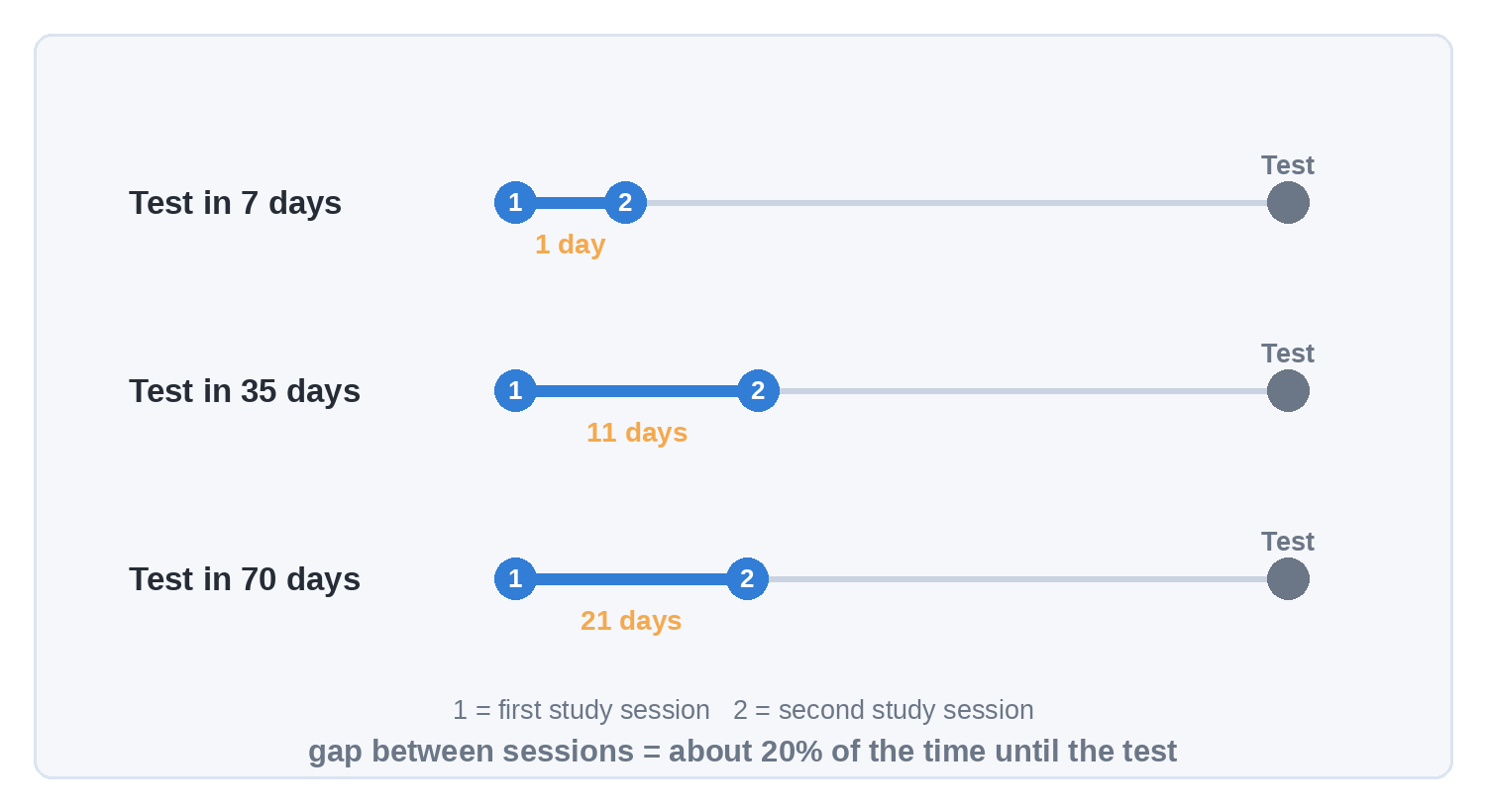
If you are learning something you want to keep permanently, such as a language or a piece of software you will use for years, the gaps want to be weeks rather than days, and each return visit can be short. Fifteen minutes of recall a fortnight later does more for retention than another hour added to tonight.
This is also the reason cramming survives despite everyone knowing it is a poor idea. It works, briefly, for tomorrow morning. The material is gone by the following month, so anything you will need twice gets learned twice.
What about highlighting, rereading and summarising?
All three scored low for the same underlying reason: each of them ends in recognition rather than recall, so the work stops one step short of the part that makes material stick.
Rereading earns its keep on the first pass through genuinely difficult material, when you are still building a picture of how the parts fit. The fourth pass through familiar text is where the time disappears. A reasonable swap is to reread once, then close the book and reconstruct the argument from memory.
Summarising scored low largely because doing it well is a skill in itself, and most people produce a shortened copy rather than a compressed understanding. It improves immediately if you write the summary with the source closed, which turns it into a retrieval exercise.
Highlighting is worth keeping if you treat the marks as a to-do list. Go back the same evening and turn every highlighted line into a question you have to answer without looking.
Does mixing topics up help or hurt?
Mixing helps for anything where you have to choose a method, because it trains the choice itself, and blocked practice never does.
When you work through twenty problems of the same type in a row, you only have to work out the method once. The second problem inherits it, and so does the twentieth, which is why blocked practice feels so fluent. Then the real situation arrives with the problems in no particular order and the hard part, recognising which method applies, has had no practice at all.
Doug Rohrer and colleagues tested this over roughly three months with 126 twelve-year-olds in a maths class, giving both groups the same problems and varying only the order in which they arrived. A day after the review session the interleaved group scored 80% against 64%. Thirty days later, when the difference matters, it was 74% against 42%.
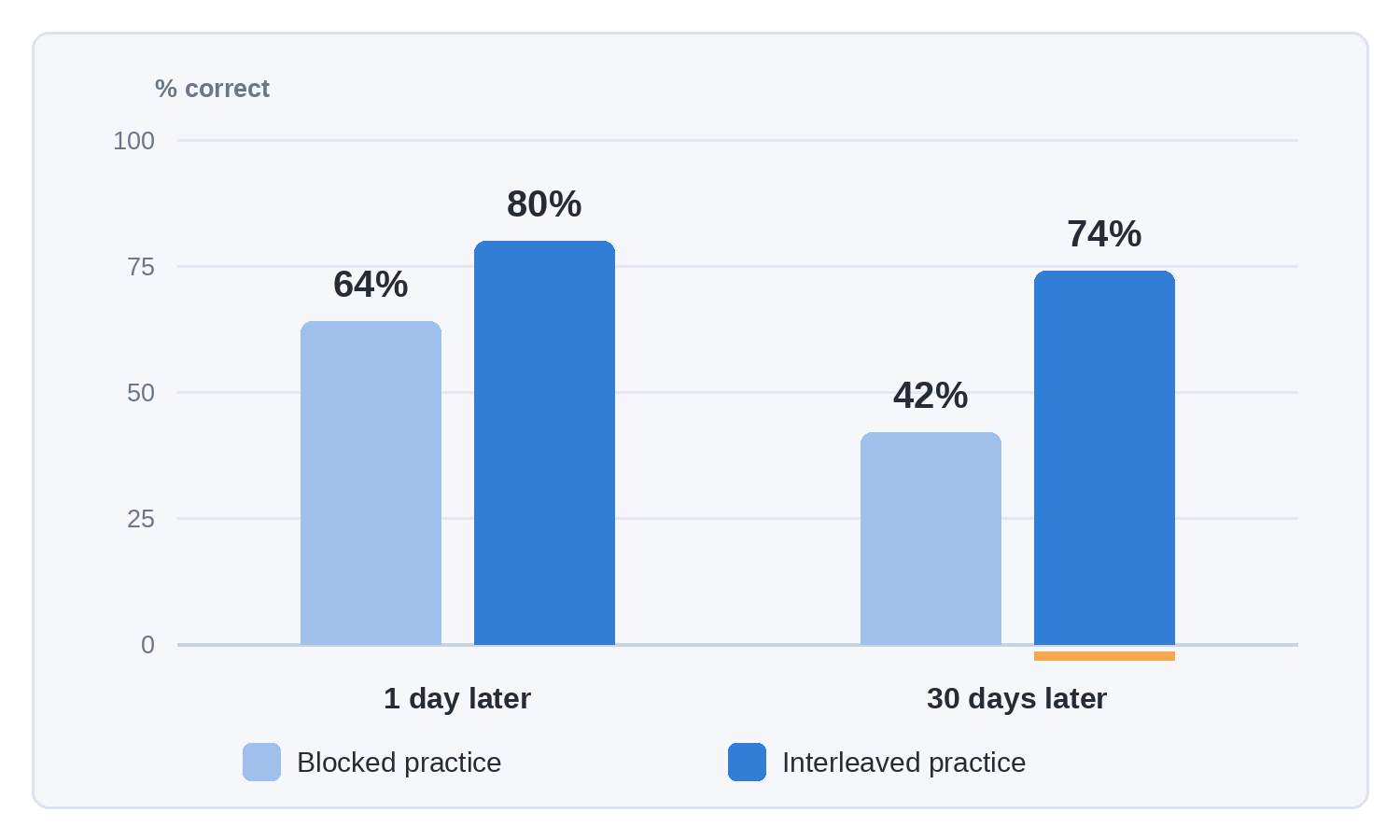
Interleaving was rated moderate rather than high because most of the strong evidence comes from maths and motor skills, and it can backfire if you mix before you have a basic grip on each individual method. Learn the method blocked, then practise it shuffled.
What does an easier week actually look like?
Four short sessions spread across the week, each ending with recall, beat one long session every time, and they cost less total time.
Here is a week that applies everything above to a single online course, at about two and a half hours in total.
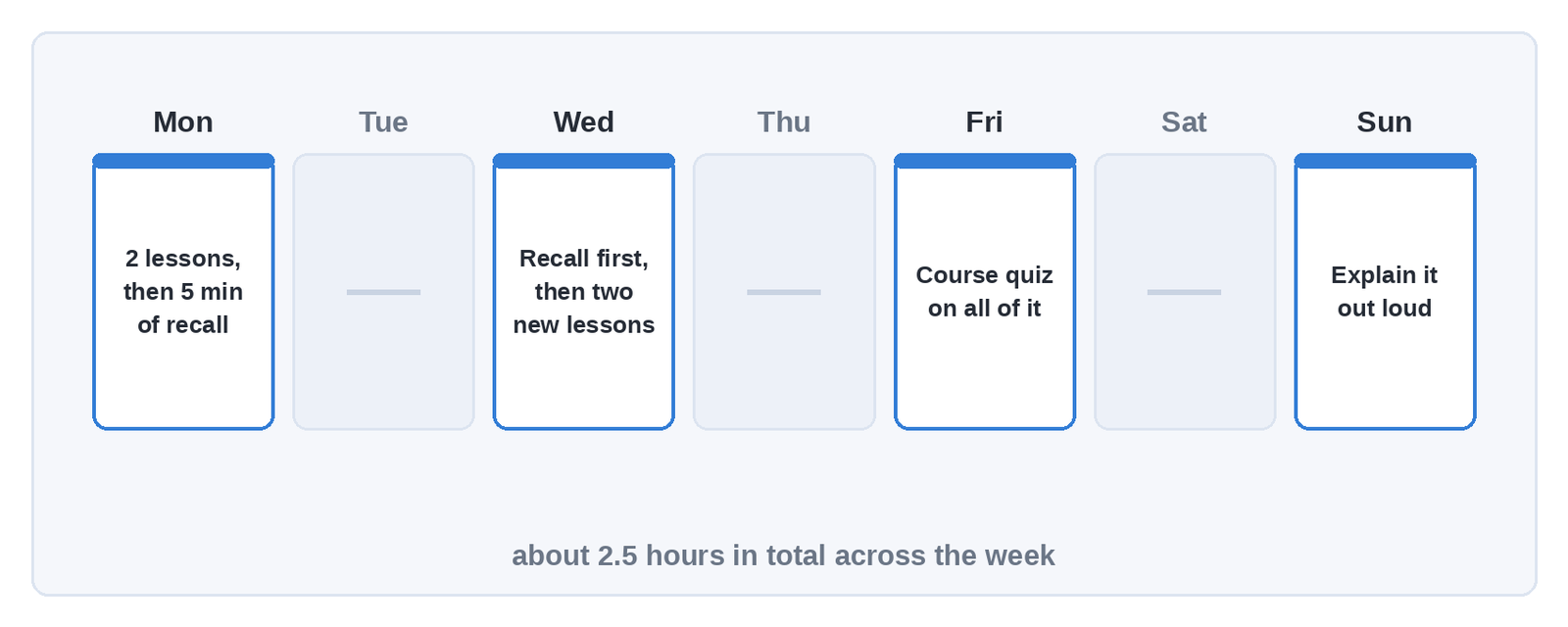
Monday you watch two lessons and spend the last five minutes writing down what you remember, source closed. Wednesday you start by answering Monday’s questions before touching anything new, which takes ten minutes and doubles as your spaced repetition. Friday you take the course quiz on everything so far, including the parts you feel confident about. Sunday you explain the week’s material out loud to someone, or to a voice recording, and note every place you stumbled.
Nothing in that week is long. The work is in starting each session with retrieval instead of ending it there, and in accepting that the sessions which feel worst are usually the ones doing the most.
Questions about learning easier
Is it better to study every day or a few times a week?
A few times a week, with a day or more between sessions, for anything you need to keep beyond a fortnight. Daily study is fine when the gaps between related sessions are still there, such as working on a different module each day.
How long should a study session be?
Long enough to cover one meaningful chunk and then recall it, which is often 25 to 45 minutes. The length matters much less than whether the session ends with you producing something from memory.
Does listening to a lesson again count as revision?
Only weakly. Replaying a lesson is the audio version of rereading, and it produces the same familiarity without the same retention. Pause the lesson every few minutes and say what has just been covered instead.
Are flashcards worth the effort?
Yes, because they are practice testing and distributed practice combined, which are the two techniques that scored highest. The gain comes from answering before you flip, so a card you recognise but cannot answer has not been learned yet.
What if I keep forgetting anyway?
Forgetting between sessions is not a failure of the method, it is the mechanism the method uses. The point of a gap is that some forgetting happens, so that retrieving the material again takes effort and strengthens it.
Start with one course and one blank page
Pick something you have wanted to learn for a while, watch the first two lessons, then close the laptop and write down what you remember. If you want a library to pick from, Soofos Plus gives you all 600+ courses for €19 a month with a seven-day free trial, and Plus Pro adds an AI coach that turns what you have just watched into quizzes and study cards, which is the high-rated method with the admin taken out.