

When a team needs training material, the usual move is to ask the person who knows the work best to write it down. It feels like the safe choice, and it tends to produce material full of gaps. Experts leave out a large share of the steps and decisions a beginner needs, because years of practice have made those steps automatic, and even a structured interview brings back only part of what is missing.
Creating training materials in-house works when the operation is built around that blind spot: the expert is the source and the accuracy check, someone who learned the task recently does the writing, a newcomer tests the draft before anyone else sees it, and every piece has a named owner and a date when it gets looked at again. This article sets out who does what, how to get the knowledge out of an expert’s head, and how to keep the result current with a team that already has a day job.
Why do experts write poor training material?
Experts write poor training material because the steps they know best are the ones they no longer notice doing. Researchers at the University of Southern California tested this directly. Sullivan and colleagues (2014, Academic Medicine) filmed three expert surgeons teaching an emergency airway procedure, a cricothyrotomy, then compared what each one said against a complete task list built separately with three other surgeons. On average, the teaching experts left out 71% of the clinical knowledge steps, 51% of the action steps and 73% of the decision steps. When they did mention an action, they explained how to do it only 13% of the time.
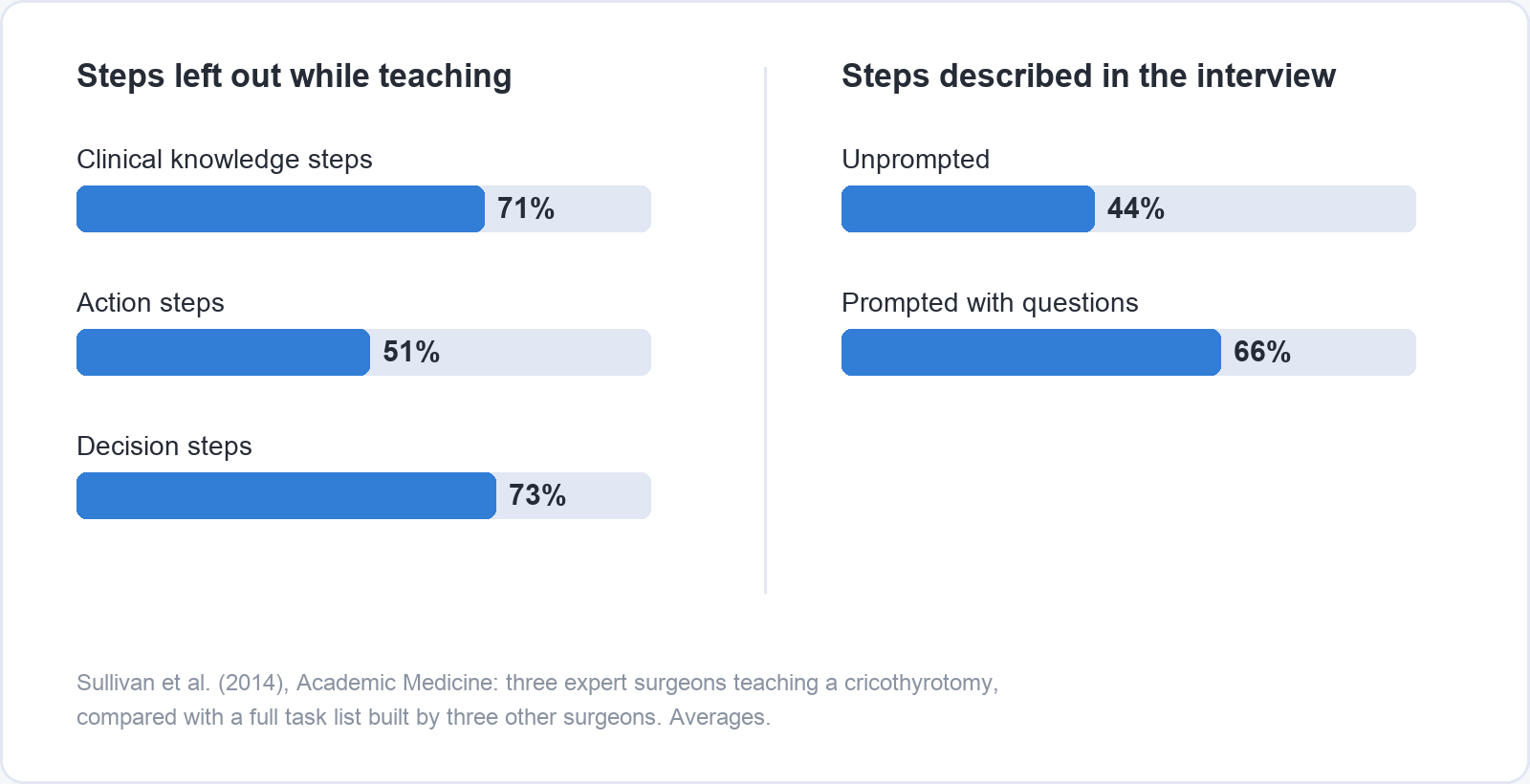
Three surgeons is a small sample, and an airway procedure is a long way from onboarding a sales team or running month-end close. The mechanism the authors describe is not specific to surgery. Ask the person who has run your payroll for nine years how a correction works and you get the four steps they think about, without the two checks they do without thinking and without the moment they decide a correction is not worth making that month. The authors put it down to automation: knowledge that has been used often enough stops being available to conscious recall, so the expert is not holding anything back.
A second line of research shows that experts also misjudge the learner. Pamela Hinds (1999, Journal of Experimental Psychology: Applied) asked experts, intermediate users and novices to predict how long novices would need for a complex task. In both of her studies, the people with more expertise predicted worse and kept underestimating even after techniques designed to correct them. Her findings suggest that people with an intermediate level of expertise may predict novice performance more accurately than experts do. An expert planning a module is therefore likely to underestimate how much time and explanation a beginner needs.
Who should write your training material?
The best writer for a piece of training material is usually someone who learned the task recently, working from the expert’s knowledge, with the expert checking the result for accuracy. The evidence for this split comes from a follow-up study. Hinds, Patterson and Pfeffer (2001, Journal of Applied Psychology) had experts and beginners give instructions to novices for an electronic circuit-wiring task. The experts used more abstract, advanced statements and fewer concrete ones. Novices taught by beginners then did better on the task itself and reported fewer problems with the instructions. Novices taught by experts did better on a different task in the same domain, which the authors attribute to the abstract concepts the experts passed on.
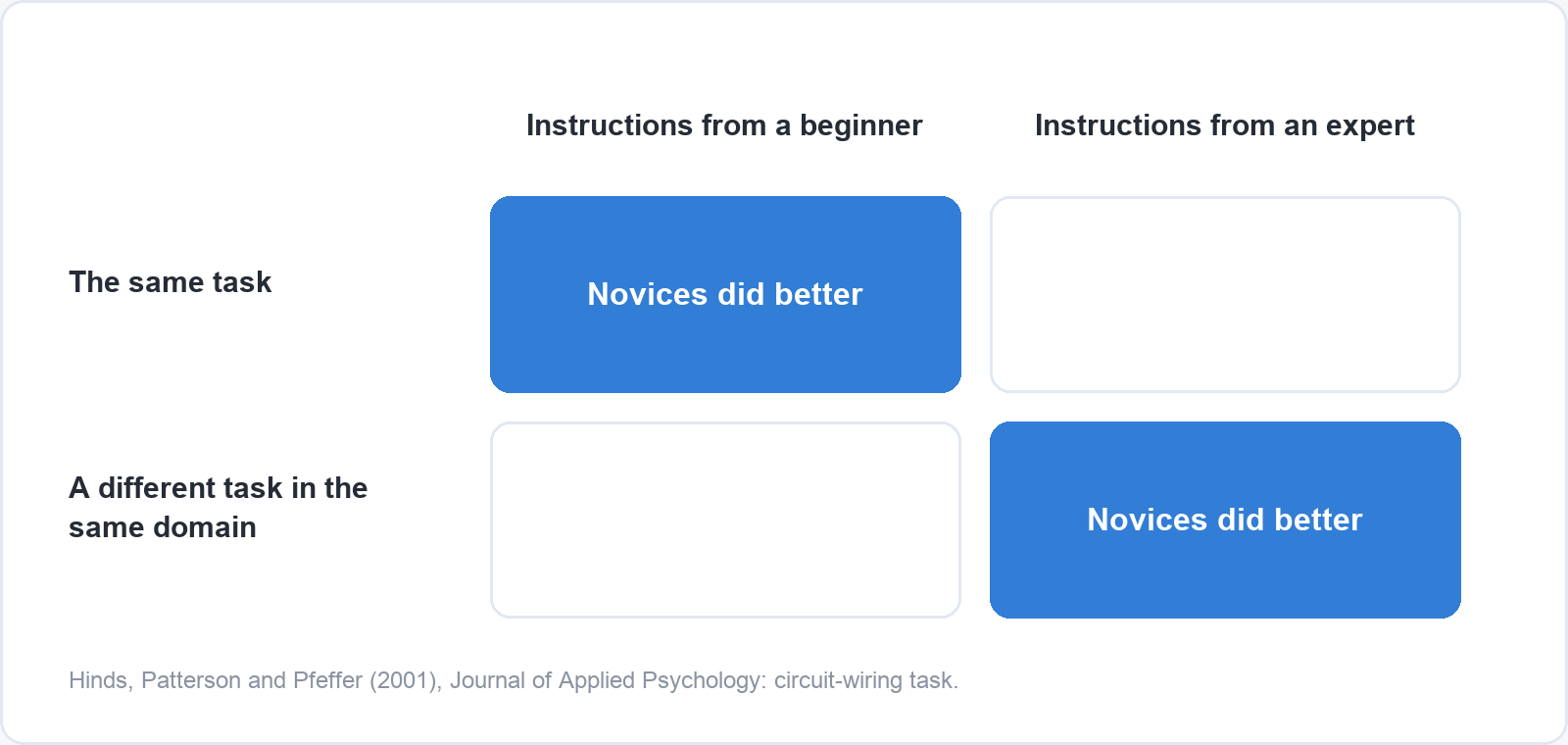
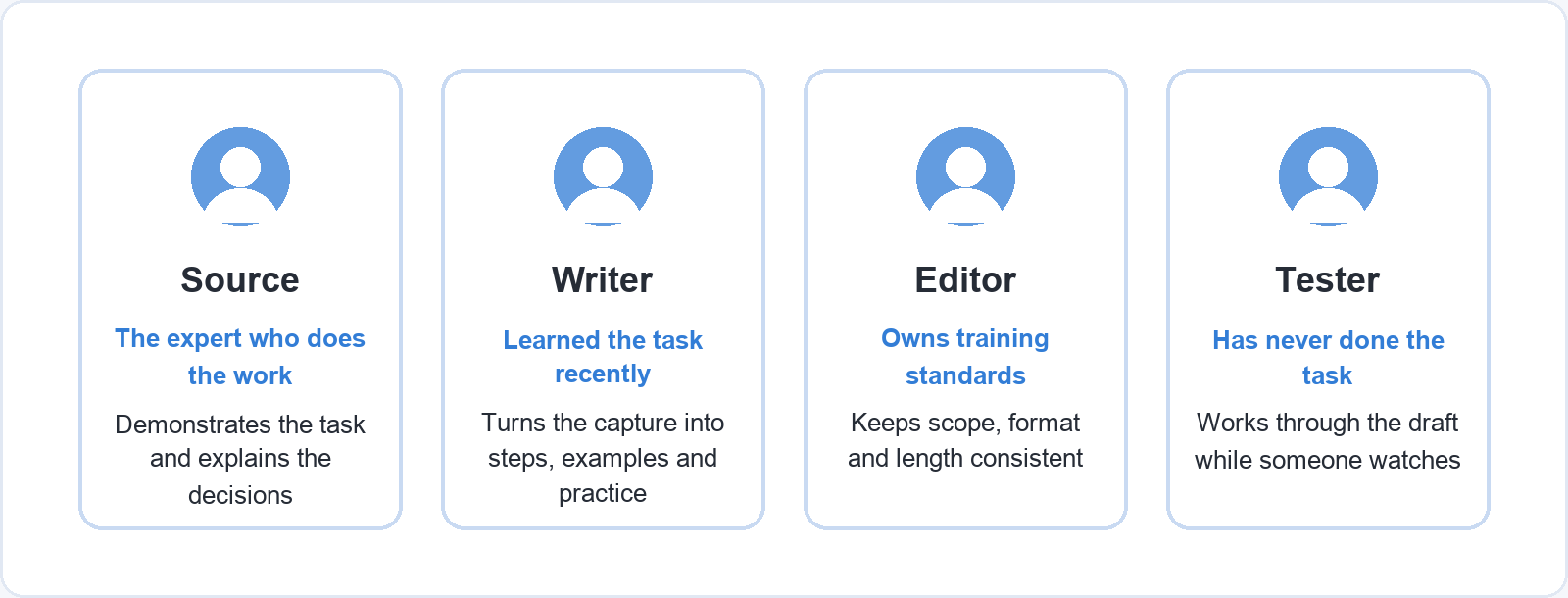
Both results are useful. The beginner writes the steps, because the beginner still remembers what was confusing. The expert supplies the principles and the judgement calls, the “why” that lets someone handle the case the steps did not cover. In practice that gives four roles, and in a small team one person can hold two of them, as long as the expert and the tester are never the same person.
| Role | Who it is | What they do |
|---|---|---|
| — | — | — |
| Source | The expert who does the work | Demonstrates the task, answers questions, explains the decisions |
| Writer | Someone who learned the task in the last year or so | Turns the capture into steps, examples and practice |
| Editor | L&D, or whoever owns training standards | Keeps scope, format and length consistent across the library |
| Tester | A person who has never done the task | Works through the draft while someone watches |
Where there is no recent learner, the editor can play that part, provided the editor really does not know the task. An L&D professional who has sat in on the process for five years knows it too well to test it, so recruit the tester from a new starter or a neighbouring team.
How do you get the knowledge out of an expert?
You get knowledge out of an expert by watching them do the work and asking about their decisions while they do it, rather than asking them to describe it from memory. This is the core of cognitive task analysis, the family of interview methods Sullivan’s team used. In their study, the share of all steps the surgeons described rose from 44% when they recalled the procedure freely to 66% once the interviewer prompted them with structured questions. Prompting recovered a lot, and it still left a third of the steps unsaid, which is why the newcomer test later in the process matters.
Book about an hour for a capture session with the expert and the writer in the room, and record it. Ask the expert to do the real task on real or realistic data and to narrate as they go. The narration will skip things; the recording will not, and the writer can go back to the moment the expert clicked something without mentioning it.
Sullivan’s results put the largest gap in the decision steps, so the questions should be about decisions and exceptions rather than steps:
- At this point, how do you know it is right? What would make you stop?
- What do new people get wrong here, and how do you notice?
- Is there a step you would skip when you are in a hurry? Why is that safe, or not?
- What would change if the amount, the customer or the deadline were different?
- Which part did you find hard when you were learning it?
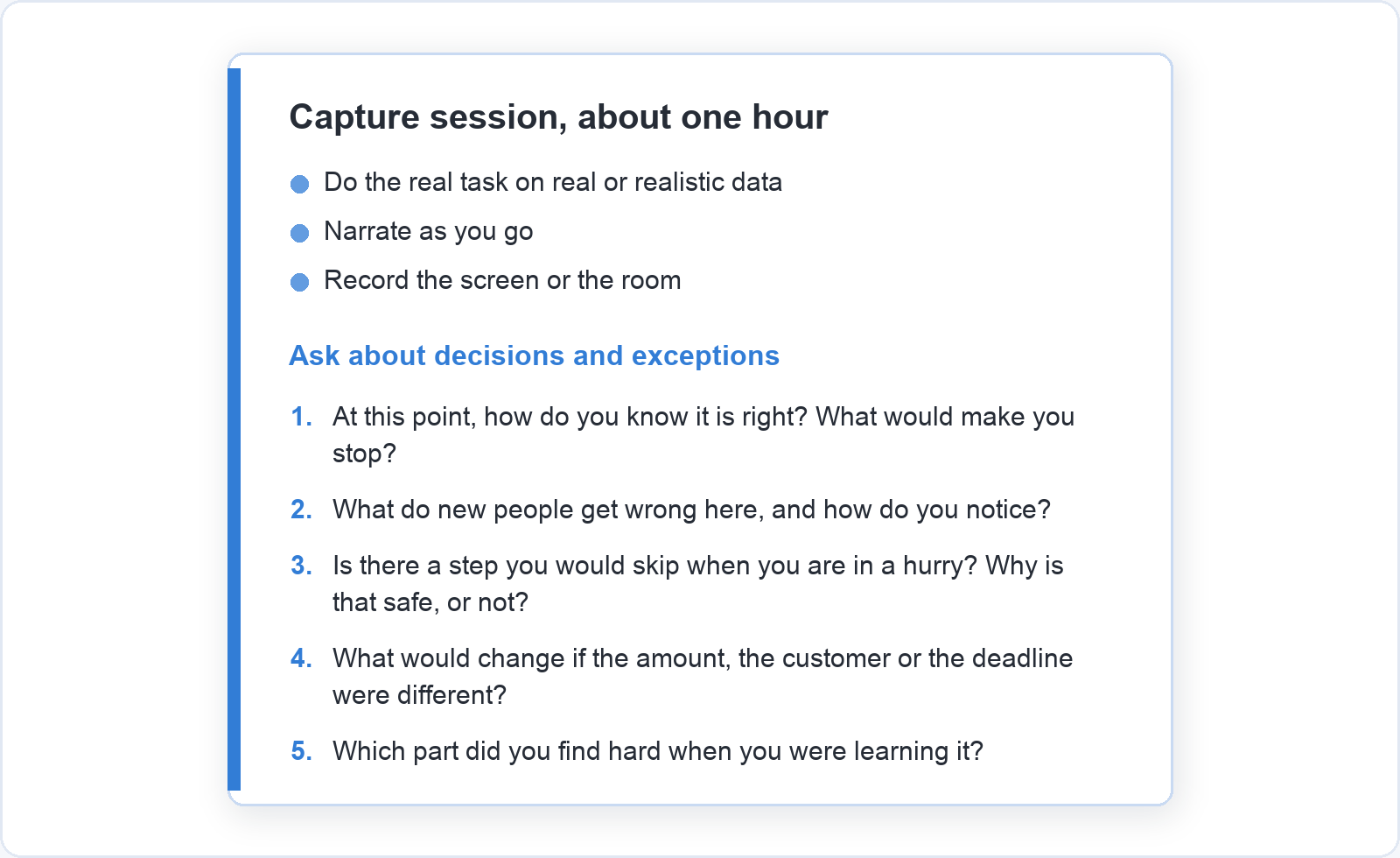
Treat the answer to the last question as a list of leads for the newcomer test to confirm, since Hinds’s work shows experts are poor judges of what beginners find hard. If the task happens away from a screen, on a shop floor or in a client meeting, film it or sit beside it, because a description given in a meeting room leaves out what the hands do.
What format should the training material take?
Choose the format by how often the task is done and how costly a mistake is. A task done every day by people who are already competent needs a one-page checklist or a short guide they can find in ten seconds. A task done a few times a year, such as a quarterly report or an annual review, needs a guide with screenshots that someone can follow cold. A task where judgement matters and mistakes are expensive, such as handling a complaint or approving a credit limit, needs practice with feedback, which usually means a short module with scenarios.
For most everyday tasks the right answer is a guide or a checklist, and a course is the exception. Where a full module is the right answer, designing it backwards from the action covers the design, the practice questions and the tools in detail. Where a task is best shown, making an instructional video in eight steps covers scripting and recording, and the capture recording from the expert session is often the raw material for it.
A production process that fits next to the day job
A repeatable process for in-house training material has six stages, and each one has a single owner. The stages are there to prevent two failures: a document written by an expert alone and never tested, and a project that stalls because nobody knows whose turn it is.
- Request. Someone asks for material and names the one task it should cover, the people who will use it and what should be different afterwards. The editor turns down requests that cover a whole job rather than a task.
- Capture. The expert and the writer hold the one-hour session described above, and the recording is saved with the request.
- Draft. The writer turns the capture into steps, examples and, where the format needs it, practice. The draft is written for the person who will use it.
- Accuracy check. The expert reviews the draft for one thing only: is anything wrong or missing that would cause a mistake. Style is the editor’s job, and the 2001 Hinds study suggests that an expert who rewrites the draft will pull it back towards abstract statements.
- Newcomer test. A person who has never done the task works through the draft while the writer watches and says nothing. Every point where they hesitate, ask or go wrong is a change.
- Publish with an owner and a review date. The editor puts the material where people will find it, with the expert’s team named as owner and a date for the next review.
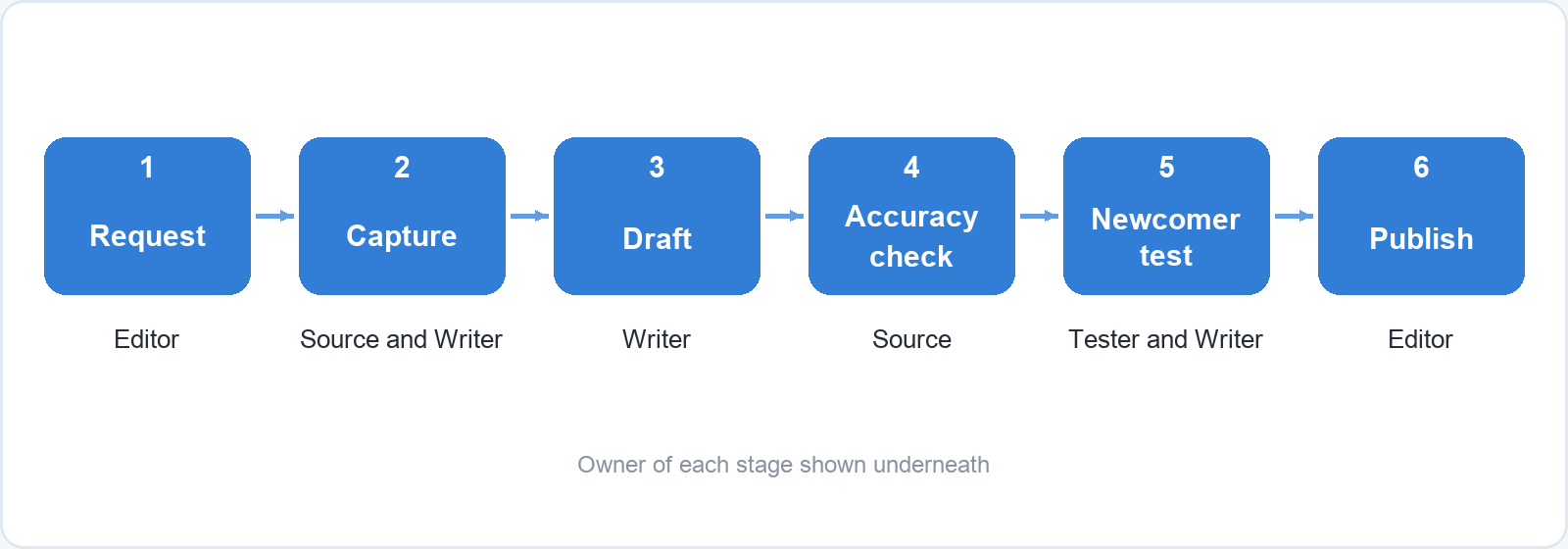
The newcomer test is the easiest stage to drop when a deadline is close, and it is the only one that checks the draft against a real beginner. It needs one person and an hour, and it is aimed at what the research says the expert cannot see: the missing steps and the time a beginner really needs. For a module going out to a large group, piloting with five people before you roll it out extends the same idea.
How do you keep training material up to date?
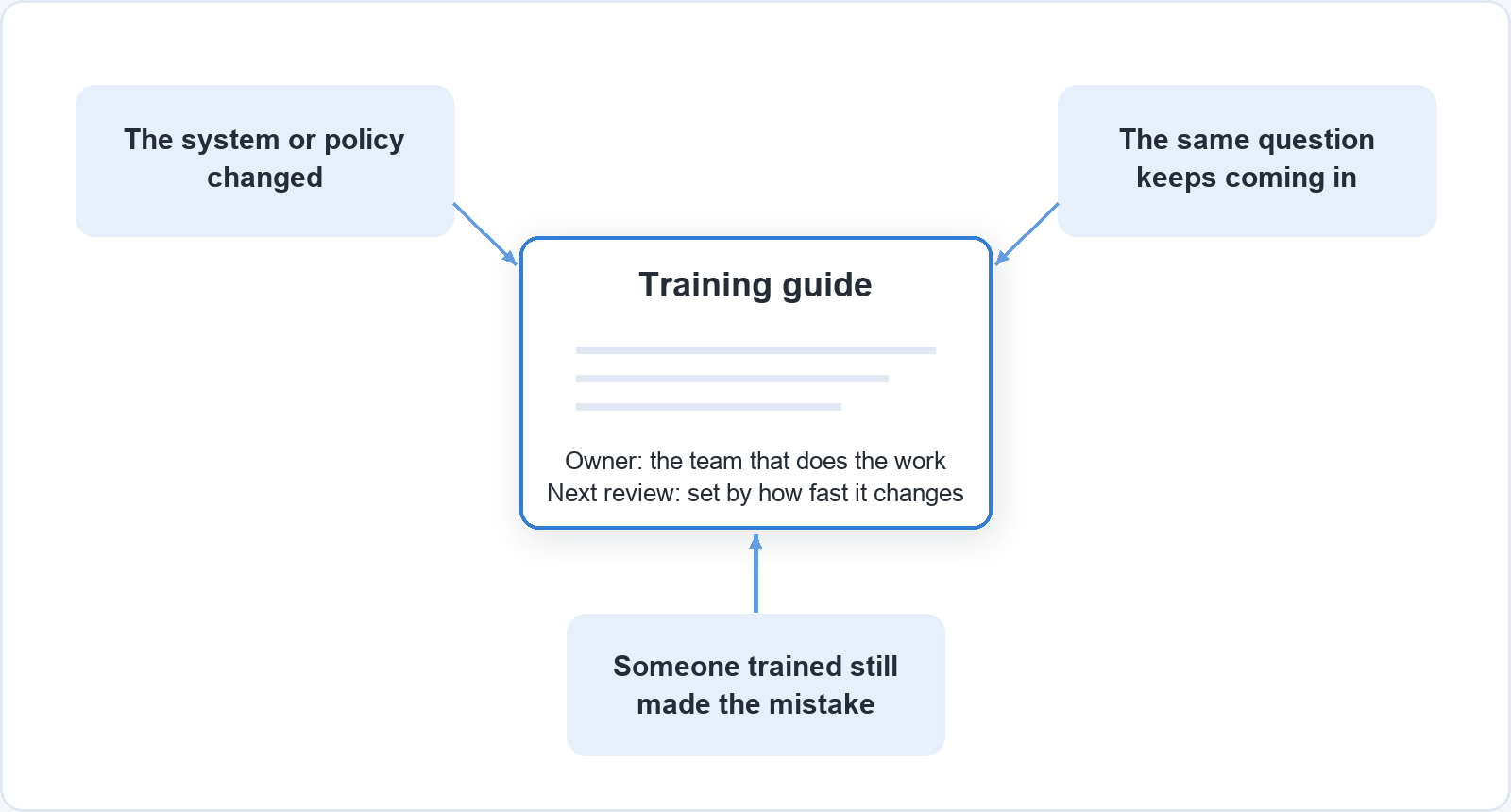
Training material stays current when every piece has a named owner outside L&D, a review date set by how fast the underlying process changes, and a trigger that brings the review forward. Material owned by “the training team” ages quietly, because the training team is rarely the first to hear that a form, a system or a policy has changed.
The owner should be the team that does the work, with the expert as the default reviewer. The review date depends on what the material describes. A guide to an internal tool goes out of date with each release of that tool, so its review is tied to the release, not the calendar. A process that rarely changes, such as how to request annual leave, can carry a yearly review date. Policy and compliance material should be reviewed whenever the policy changes, and it is worth checking with whoever owns the policy how often that is.
Three signals should bring a review forward whatever the date says: a change to the system or policy the material describes, the same question reaching a manager or a help desk more than once, and a mistake on the task by someone who has completed the training. Each of them is evidence that the material and the work have drifted apart, and the owner should check the material within a few weeks rather than at the next scheduled date.
Retiring material is part of the same job. A guide nobody has opened in a year, or one describing a process that no longer exists, should be removed rather than left to compete with its replacement in search results. At the level of the whole catalogue, the owner and retirement rule for an online academy sets out how to run that across a library.
Should you write it yourself or buy it?
Write the material that is specific to your organisation and buy the material that is not. Your expense process, your internal tools, your safety procedures on your site and the way your team handles its own customers can only come from inside, and they are where the expert-and-writer process earns its time. Excel, giving feedback, time management, presenting and most leadership basics are the same in every company, and a well-made external course is usually better than what a busy team can write between other work.
That division also protects your experts’ time, which is the scarcest input in the whole process. An hour of capture spent on how your warehouse handles returns produces something no supplier can sell you. An hour spent on how to write a formula in a spreadsheet produces a weaker version of something that already exists. Buying online does not cost learning either: people learn about as much online as in a classroom when the teaching is the same, so a good online course on a generic skill is a fair substitute for a session your own team would have run.
Questions people ask about creating training materials
What is a subject matter expert in training?
A subject matter expert, often shortened to SME, is the person who knows the task or topic the training covers, usually because they do it every day. In a well-run process the SME is the source of the content and the check on its accuracy, and someone else turns that content into material a beginner can follow.
Can AI write our training materials from existing documents?
AI tools can produce a first draft quickly from documents, recordings or transcripts. They do not solve the expert’s blind spot, because the documents they work from were usually written by experts and leave out the same steps. A draft from an AI tool still needs the accuracy check by the expert and the newcomer test, and a capture recording is a better input than a policy document because it shows the steps nobody wrote down.
How do you get experts to make time for it?
Ask for less of their time and ask for it in a fixed shape: one recorded hour to capture the task and one shorter review for accuracy, with the writing done by someone else. The expert never has to produce a document. A manager who books the capture session into the expert’s calendar does more for the programme than any request sent by email.
How long should a piece of training material be?
As long as one task needs and no longer. A checklist can be a single page, a guide for an occasional task runs as long as its screenshots need, and a module with practice is usually measured in minutes rather than hours. If a draft covers several tasks, split it into several pieces with their own owners and review dates.
How often should training materials be reviewed?
Tie the review to how often the underlying process changes: at every release for material about software, whenever the policy changes for compliance material, and around once a year for stable processes. Bring the review forward when the system changes, when the same question keeps reaching managers, or when someone who completed the training makes the mistake it was meant to prevent.
Who should own training material, HR or the business?
The team that does the work should own the content, and HR or L&D should own the standards and the platform. That split puts the people who first hear about a change in charge of updating the material, and keeps the format, the length and the place it is published consistent across the organisation.
Where to put what you make
Material your team creates in-house is easier to find and to assign when it sits in the same place as everything else people learn from, with the same login. On Soofos for Business you can add your own company training, such as onboarding, safety or internal tools, and assign it alongside the Soofos course library, with completion tracked per person, so your experts’ hours go into the material only your organisation can make.