



You buy an online course, watch the first lessons, and a month later you can’t remember much of it. Sound familiar? Here is an answer to whether e-learning works: when it does, when it doesn’t, and what makes the difference between a course you finish and one you forget.
The short answer: it can work, but not by itself
E-learning can work well, but only when a few things are in place: you do something with each lesson, you come back to it later, and the course fits the week you actually have. A course is a set of lessons. What you still know a month later depends mostly on how you worked through those lessons, and much less on the platform or the video quality.
That puts the deciding part in your hands. Picture two people who buy the same spreadsheet course on the same day. One watches the videos in the evening, follows along and clicks on to the next lesson. The other pauses after each lesson, rebuilds the example in their own household budget, and opens the course again a few days later to check what stayed. Both watched the same hours of video, but only the second one practised, so only the second one can build the budget again without the lesson open.
If you want to know how online teaching compares with a classroom, we went through that question separately in online learning vs classroom. The rest of this article is about you and the next course you take: when learning online works, where it falls short, and the habits that help you keep what you learn.
When learning online works well
Learning online works best when you set the pace yourself, fit short lessons into gaps in your week, and use what you learn soon after. A good teacher on screen adds the fourth ingredient: someone to copy and a reason to keep going.
You learn at your own pace. In a classroom the teacher moves on when most of the group is ready. In a video lesson you can pause on the step you missed, go back thirty seconds, or watch the whole lesson again the next morning. Nobody sees how often you replay a lesson, so there is no cost to admitting you didn’t get it the first time.
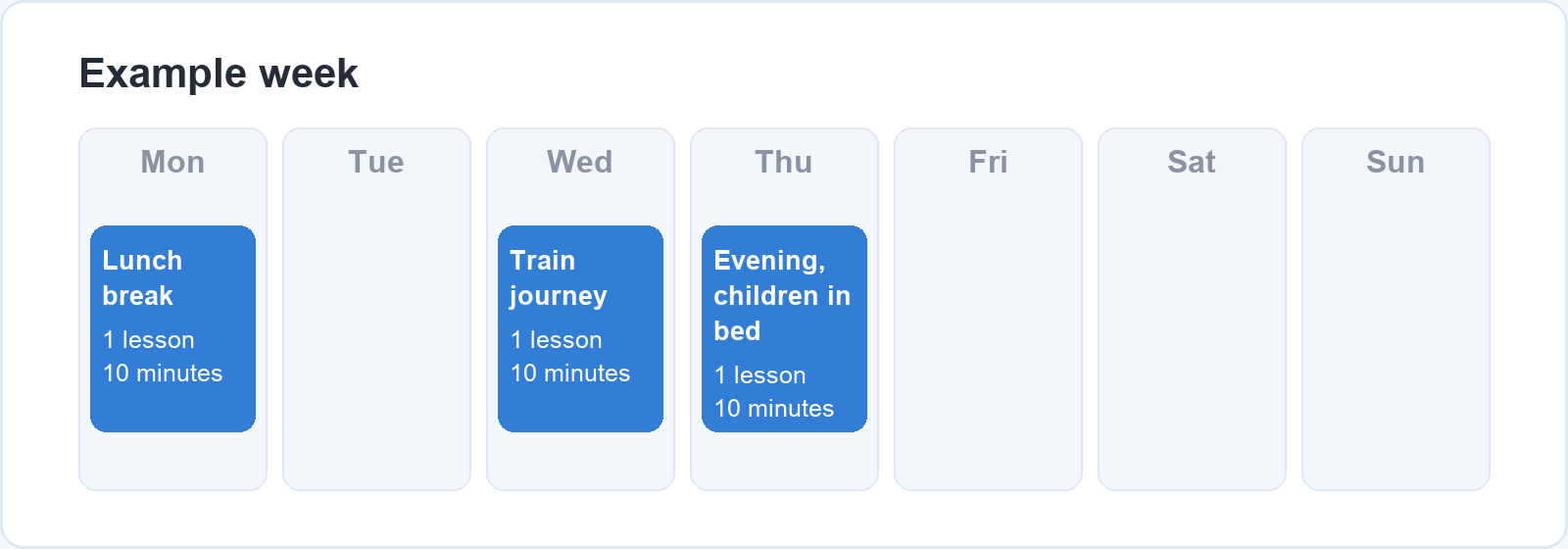
Short lessons fit a busy week. A course built from ten-minute lessons fits into a lunch break, a train journey or the half hour after the children are in bed. You don’t need a free evening to make progress, and a spare moment is enough to move one lesson forward.
It works best when you use what you learn straight away, at work or at home. If you learn how to build a drop-down list on Tuesday and put one in Wednesday’s team rota, the lesson has a job to do and you will remember where to find it. If you learn it for some day in the future, you are relying on memory alone until that day comes, and it may be months away.
A real teacher who shows you how it’s done helps more than you might expect. Watching an experienced photographer change the settings for a portrait against a bright window, and hearing why, is much closer to standing next to them than reading a list of settings. It also helps you keep going, because you know whose course you are following and what they can do. Every course on Soofos is taught by a real person with real passion for the subject, not a presenter reading a script, and you see who is teaching you before you start.
Where e-learning works less well
E-learning works less well for skills that need hands-on practice with someone correcting you, and it tends to stall when nobody expects you anywhere at a set time. Both are limits of the format, and both can be planned around once you know about them.
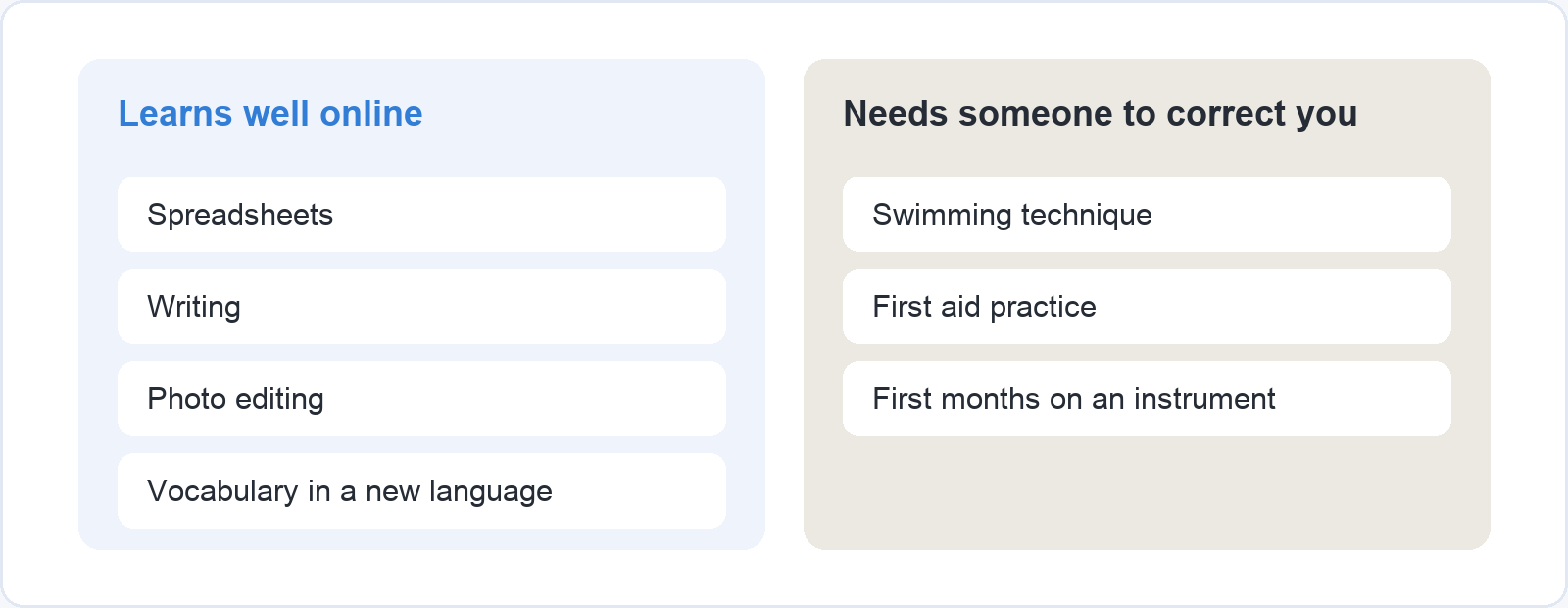
Some skills need practice and direct feedback from someone in the room. You can learn what good swimming technique looks like from a video, and you can learn the steps of first aid, but someone has to watch you do it and correct your arms or your hand position. The same goes for the first months on a musical instrument, where a teacher spots a bad habit in your grip before you notice it yourself. Online learning is strongest for skills you practise on a screen or on paper: spreadsheets, writing, photo editing, the vocabulary of a new language. For physical skills, use an online course for the knowledge and find a place to practise with feedback.
Watching without doing anything yourself rarely sticks. While a teacher explains, everything makes sense, and that feeling of following along is easy to mistake for knowing it. The test comes when the video is closed and you have to do it yourself. Trying each step during the course, while the lesson is still open, means that moment is not your first attempt.
Without a fixed moment in your week, a course easily slips to the bottom of the list. It waits for a free evening, and free evenings fill up with other things. A course bought in January is easy to lose track of by March when no time in your diary belongs to it.
No one checks on you, so online learning asks for a bit of discipline. In a classroom someone notices when your chair is empty; online, nobody does. That says nothing about whether you are good at learning. It means the structure a classroom gives you for free has to come from somewhere else, and a fixed time, lessons that fit the time you have and a small task after each lesson do most of that work.
Habits that help you remember what you learn
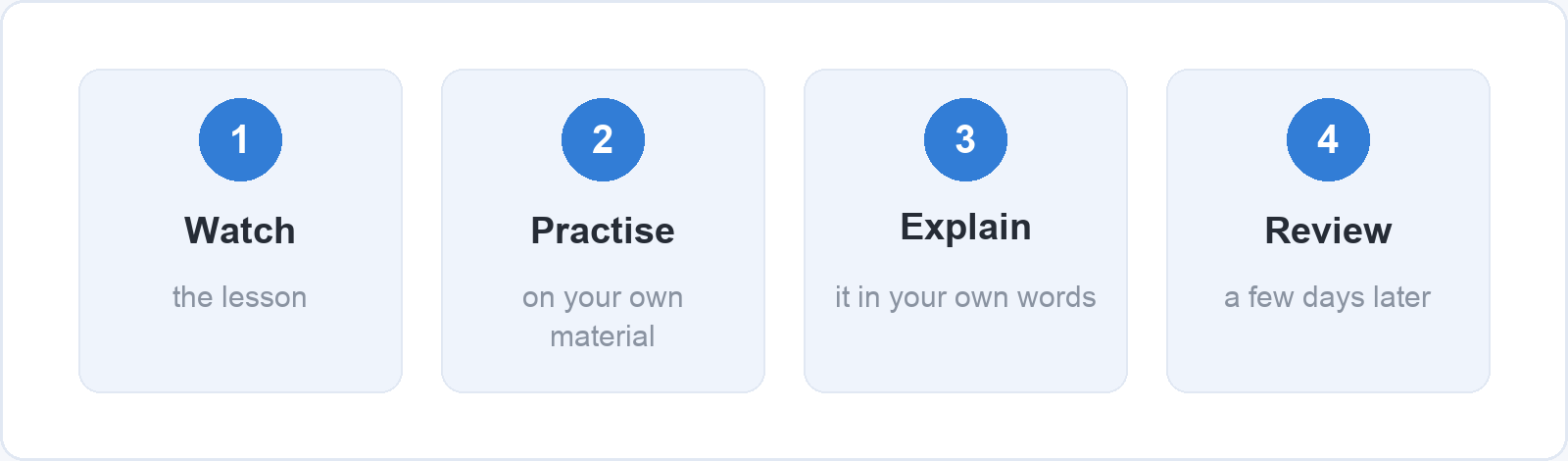
Four habits make the biggest difference: practise straight after a lesson, explain it in your own words, come back to it a few days later, and keep your sessions short and regular. None of them needs special tools; a notebook and your diary are enough.
Practise straight after a lesson instead of only watching. Close the video and do the thing the lesson showed, on your own material: your own spreadsheet, your own photo, your own email. If the lesson showed a formula, type it into a file you use. If you can’t do it without the video, go back to the step where you got stuck before you move on.
Explain what you learned to someone else, or write it down in your own words. Tell a colleague or a friend what the lesson was about, or write three or four sentences from memory without looking at your notes. Where you get stuck or go vague is the part you have not understood yet, and that is the part to watch again.
Come back to it a few days later for a quick review. Before you start the next lesson, take five minutes to write down what you remember from the last one, then check. Testing yourself like this and spreading your study over several days are the two methods with the strongest support in learning research; we ranked ten study methods by their evidence in how to learn easier.
Keep lessons short and regular, rather than long and once in a while. Three sessions of twenty minutes on different days give you three chances to come back to the material, while one long Sunday session gives you one. If your phone keeps pulling you out of those twenty minutes, our guide to using your phone less has methods that help.
How to pick a course you will actually finish
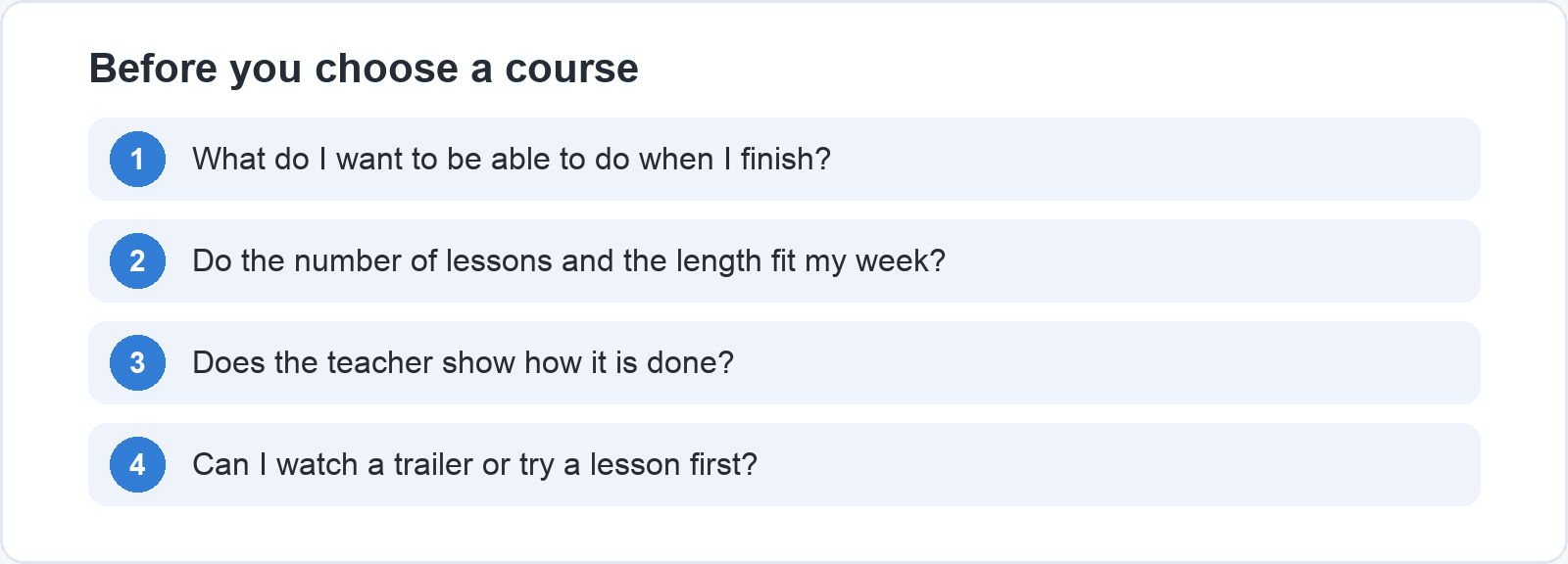
A course you will finish starts with one clear thing you want to be able to do, has a lesson list and length that fit the time you have, and is taught by someone who shows you how. If the course page offers a trailer or a free lesson, watch it before you pay.
Start with one clear thing you want to be able to do, not a vague wish. “Get better at Excel” gives you no way to choose between courses and no moment when you are done. “Build a monthly budget that adds up by itself” tells you which course to pick, which lessons matter most, and when you have reached the goal.
Look at the lesson list and the length, and ask whether it fits the time you really have. The course page should show the number of lessons and the total running time. A course with 15 lessons, taken at two lessons a week with practice after each one, takes about eight weeks. If you know that your evenings are full until the summer, a shorter course you finish is worth more than a long one you abandon halfway.
Check who the teacher is and whether they show you how it’s done. Read the instructor’s profile and watch any free preview. A teacher who works on screen, in their own files or with their own camera, gives you something to copy. A course that ends each lesson with a small task gives you a reason to practise.
Try a first lesson before you commit, if that is possible. Some course pages have a trailer or a preview lesson. On Soofos you can also start with one of the free courses, to find out how online lessons fit into your week before you pay for anything.
A good place to start
If you want to put these habits into practice with someone guiding you, our course Learn smarter: remember what you learn is built around them. Anton Verkooijen, one of the co-founders of Soofos, explains why you forget, how to test yourself instead of rereading, how to set up a simple repetition schedule, and how to make a study plan that holds up alongside work and family. It has 15 lessons over 2 hours and 22 minutes, and each lesson ends with one small task to do that week, so you practise each method on whatever you are studying at the moment.
A good first step is to choose the one course you most want to finish, put two short sessions for it in your diary this week, and watch the trailer of Learn smarter: remember what you learn to see whether it suits you.