

Graphic design is the work of arranging type, images, colour and space so that one specific message reaches one specific reader and gets them to act on it. Almost every definition you will find settles on the phrase “visual communication”, which is accurate and tells you very little about the job. The part that goes missing is the decision a designer makes on every single piece of work: what should this person notice first, what second, and what can wait until they are already interested.
Two posters carrying identical words can perform completely differently, and the difference is almost never the quality of the drawing. It is the order of attention. That is what this article is about, along with what designers actually do between the brief and the finished file, which branches of the field exist, what the software costs in 2026, and whether the work is worth learning now.
What is graphic design, in one sentence?
Graphic design is visual communication done to a brief. The brief is the part that separates it from everything else: a designer is handed a job (sell this, explain this, make this findable in a hurry) along with constraints such as a budget, a fixed size, a set of brand colours and a deadline, and the result is judged on whether the job got done. A painting can be entirely about the person who made it. A train timetable cannot, because a passenger who misses the 07:14 has been failed by it, however handsome the type was.
The name itself is older than the story usually told about it. Design writing routinely credits the typographer William Addison Dwiggins with coining “graphic design” in 1922, but the letterform historian Paul Shaw traced the phrase in print several years earlier. The Printing Art reported in 1920 that “the arts of graphic design and modeling in clay” were taught at the Estienne printing school in Paris, and a California Teachers Association journal listed a course called “Graphic Design and Lettering” in 1921. Dwiggins used the phrase once, in passing, in an article about advertising.
What does a graphic designer actually do all day?
Most of a designer’s working day goes on deciding and revising rather than drawing. The software is the last stretch of a longer loop, and a designer who skips the early part of it produces work that looks finished and does nothing.
The loop usually runs like this. A brief arrives, and the first job is to interrogate it: what does this piece have to achieve, who is going to see it, where will they see it, how long do they have, what does it need to avoid saying. Then comes research, which is less glamorous than it sounds and mostly means looking at what competitors do, what the brand has done before, and what the format physically allows. Concepts follow, usually several, deliberately different from each other rather than three shades of the same idea. One gets chosen, then it goes through rounds of feedback, and the work narrows.
The final stretch is production, and it is where a lot of otherwise good design falls over. Print files need bleed, the right colour space, fonts either licensed or converted to outlines, and a resolution that survives the press. Digital files need exports at several sizes, sensible file weights, and text that stays readable on a phone held at arm’s length on a bus. None of this is creative work, and all of it is the difference between a design and a delivered design.
Why is visual hierarchy the centre of the job?
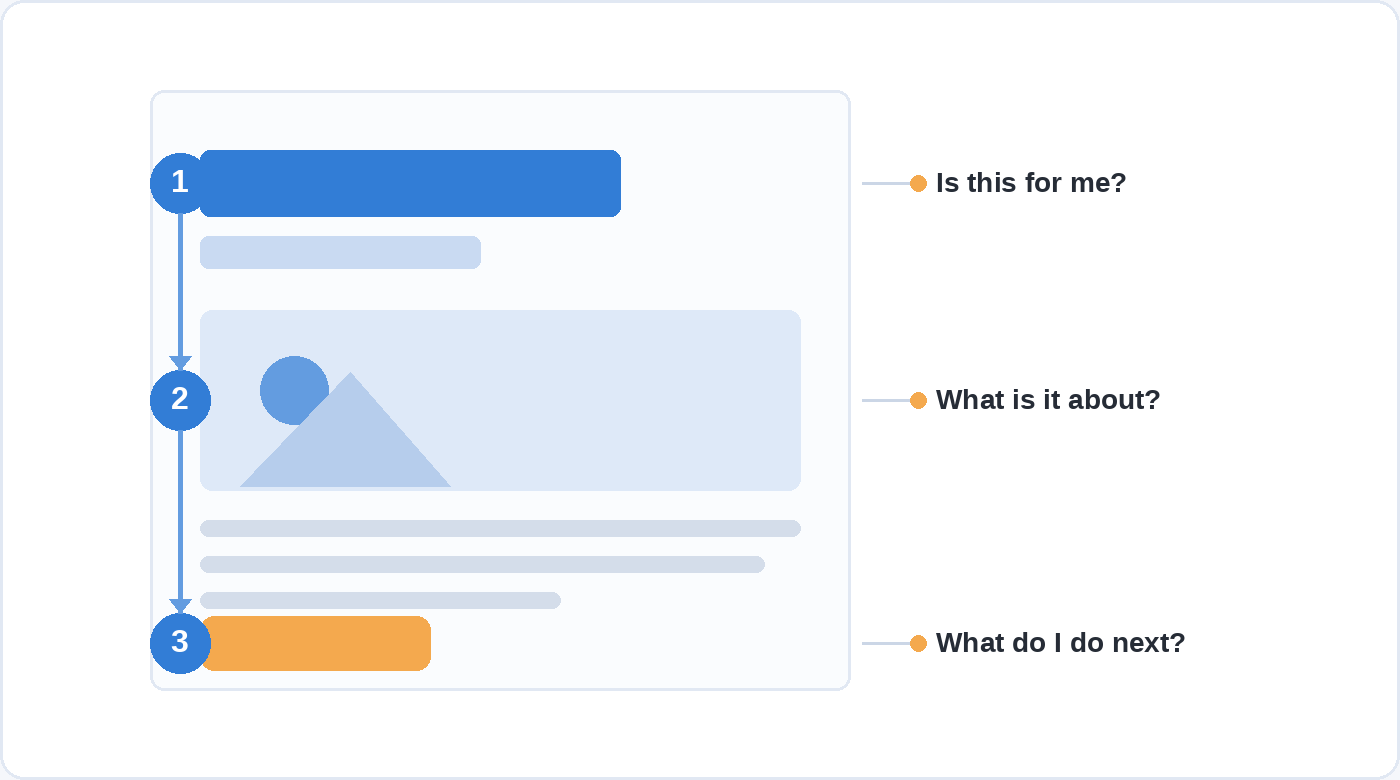
Visual hierarchy is the order in which a design makes you notice things, and it is the single decision that most affects whether a piece works. Everything else a designer knows is a tool for building it.
Picture a poster for a small gig. It has to carry eight pieces of information: the band, the support act, the venue, the date, the door time, the ticket price, a QR code and a licensing logo the venue is obliged to show. A reader walking past gives it roughly three glances, and the design decides what lands in each one. Glance one has to answer “is this for me”, so the band name wins. Glance two answers “can I go”, which is the date and the venue. Glance three carries everything needed to act, so the price and the QR code sit together. The licensing logo goes small at the bottom, because it is a legal obligation rather than a message.
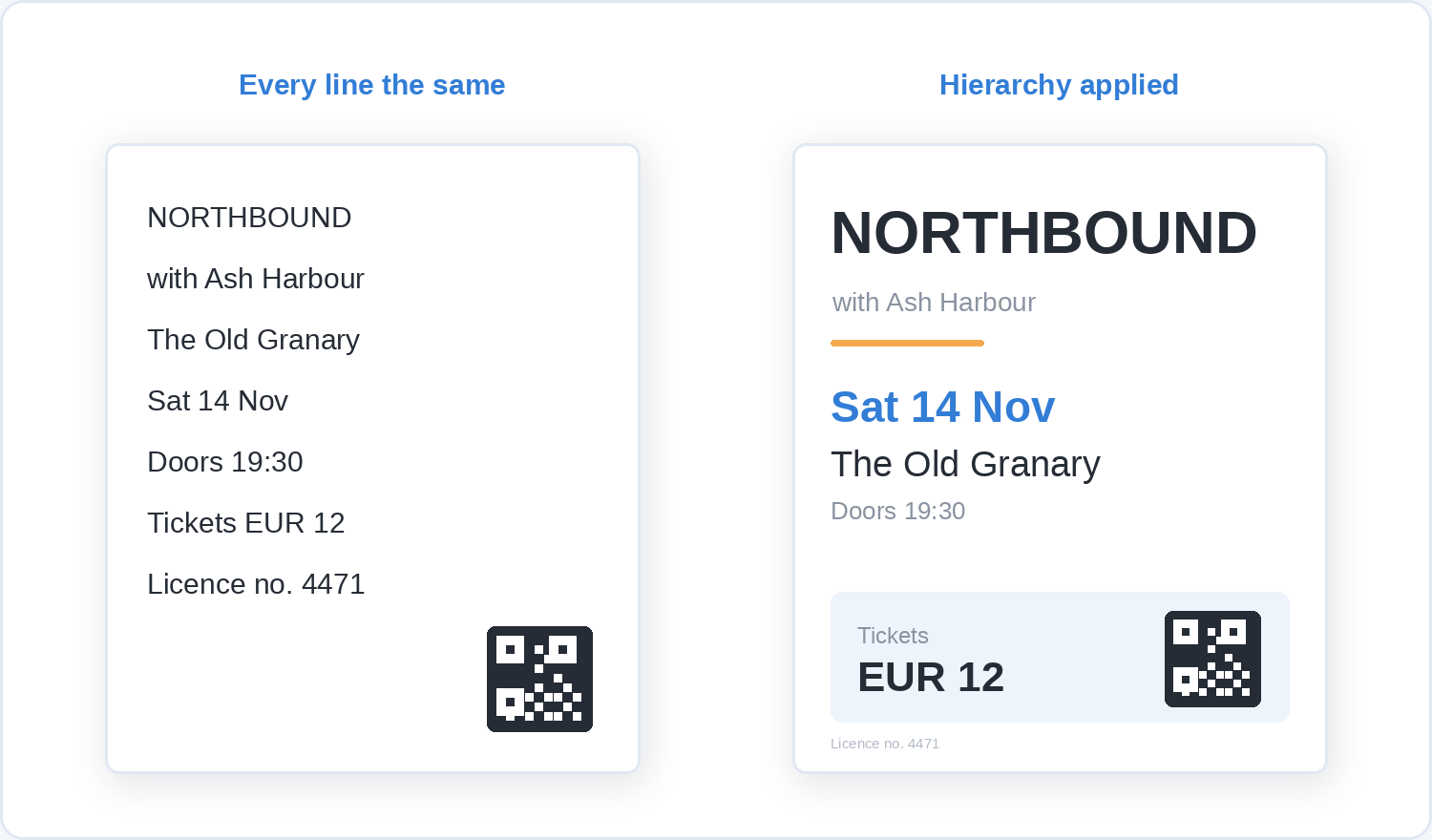
Set every line at the same size and the reader has to do the sorting themselves, which mostly means they do not bother. Set the hierarchy wrong, with the licensing logo big and the date small, and the poster is worse than a blank wall because it wasted the glance. The words did not change in either version.
What are the elements and principles of graphic design?
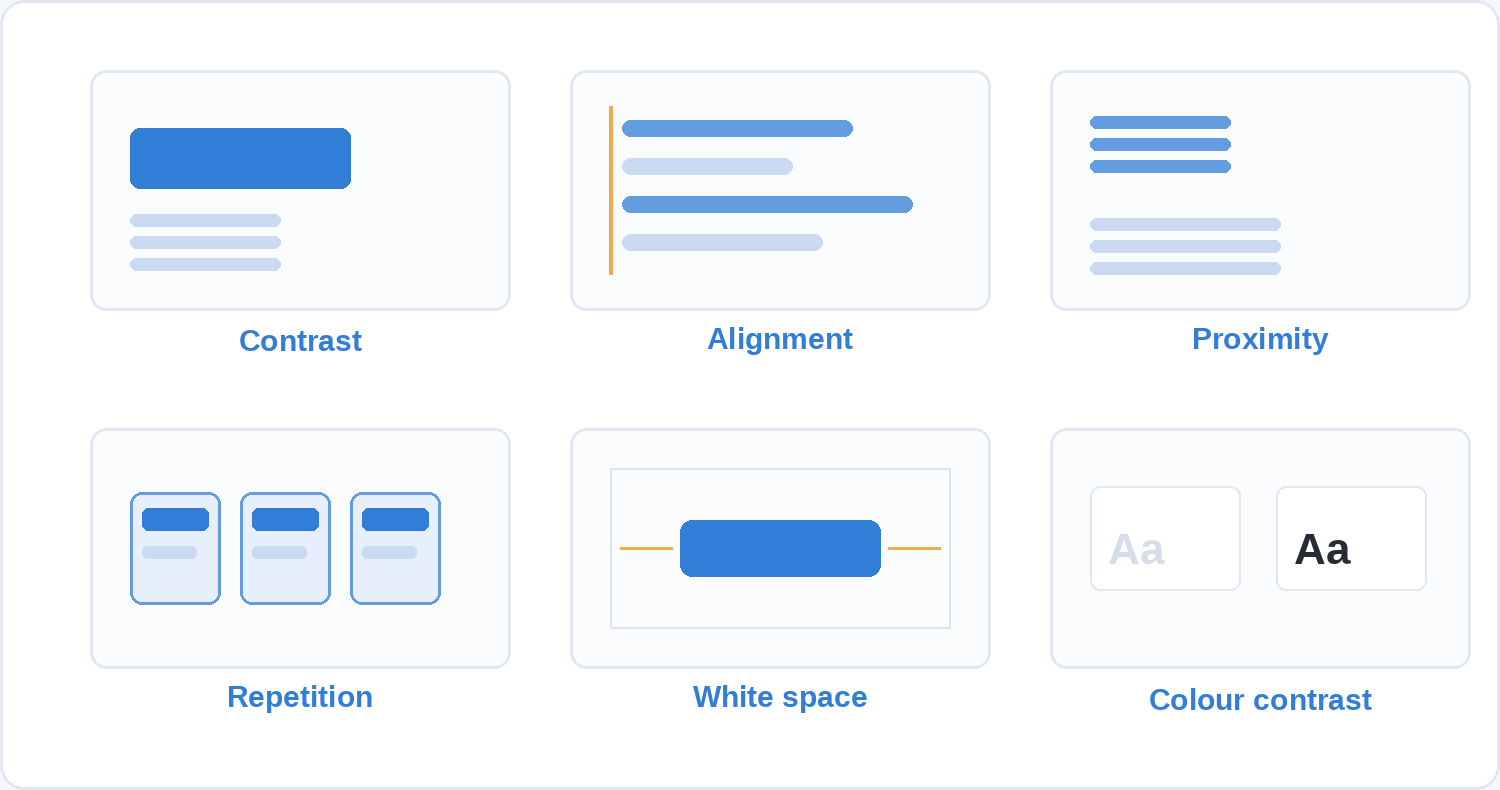
The classic elements are line, shape, colour, texture, space, form and typography, and the classic principles are contrast, balance, alignment, proximity, repetition, scale and white space. Learning the vocabulary takes an afternoon. Learning what each one does to a reader’s attention takes considerably longer, so it helps to meet them as levers rather than as a glossary.
Scale and contrast are the loudest levers you have. Anything much bigger, darker or more saturated than its neighbours gets read first, which means a design with six emphasised items effectively has none.
Alignment creates the invisible lines that make a layout feel deliberate. Most amateur work reads as messy for this reason alone, and the fix is usually a grid rather than better taste.
Proximity tells the reader what belongs together. A caption sitting closer to the wrong photograph is read as belonging to it, whatever the words say.
Repetition is what makes ten pages look like one document. Consistent heading sizes, consistent spacing, the same two typefaces throughout.
White space is the most misunderstood of the set. Empty area is working area: it gives the important thing room to be noticed, and cramming a layout is the fastest way to flatten a hierarchy you have already built.
Colour carries meaning before anyone reads a word, which is why it is worth checking contrast ratios rather than trusting your own eyes. Pale grey text on white passes on a designer’s calibrated monitor and disappears on a phone in daylight.
What are the main branches of graphic design?
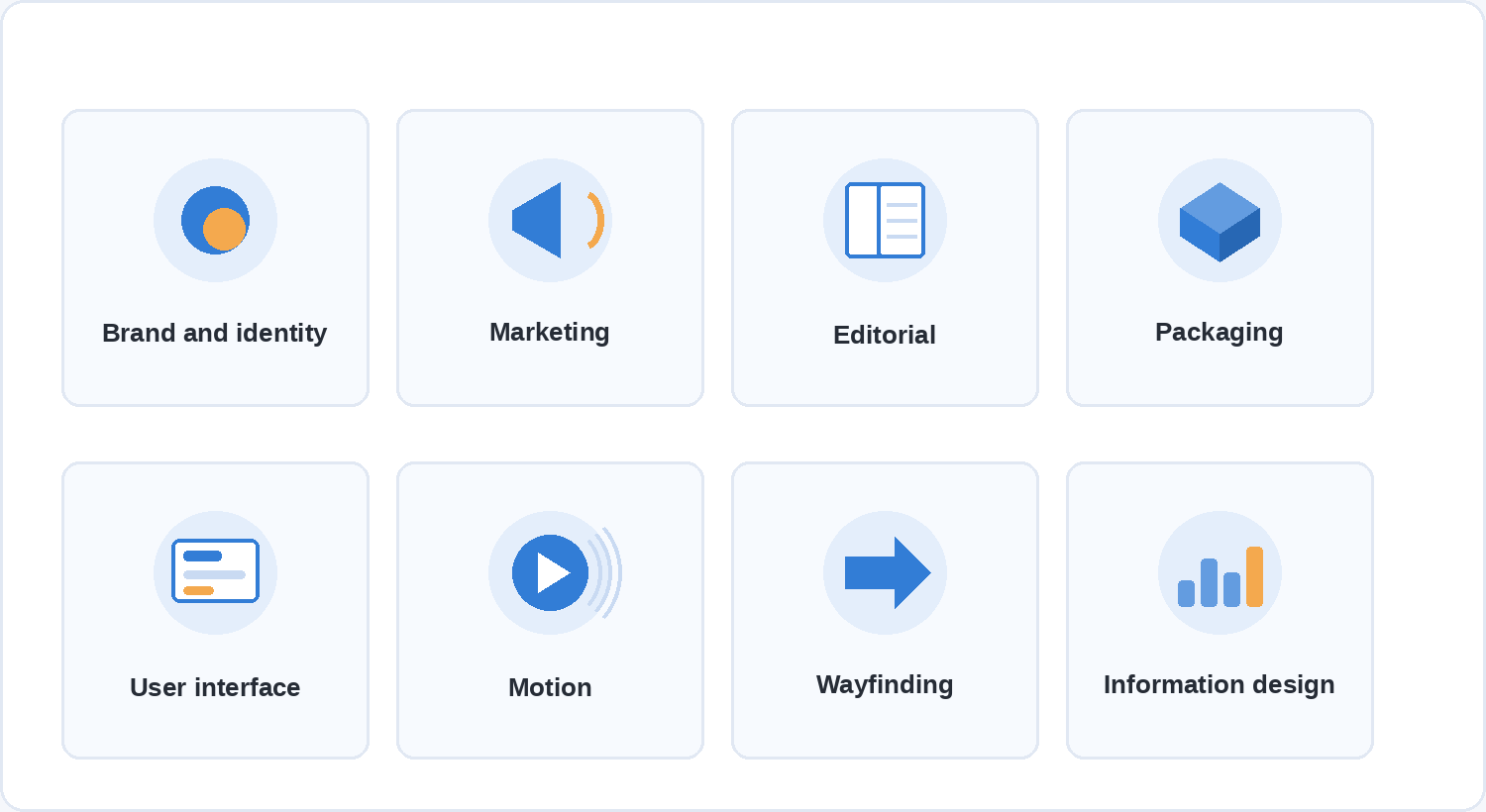
Graphic design is not one job, and the skills transfer unevenly between its branches. Someone excellent at packaging may be lost in motion work.
Brand and identity design builds the system: the logo, the typefaces, the colour palette and the rules that keep them consistent across everything the organisation makes. Marketing and advertising design produces the campaign work that system enables, from social posts to billboards. Publication and editorial design handles long-form text, which is a craft of grids, typographic detail and stamina rather than of striking single images. Packaging design is the only branch where the output is a physical object with structural and legal requirements attached. User interface design arranges screens people operate rather than pages people read, so it overlaps with user experience work but is not the same discipline. Motion design adds time as a dimension, which changes hierarchy completely, because you can now control the order of attention directly. Environmental and wayfinding design covers signage and exhibitions, where the reader is walking. Information design turns data into something a person can act on, and includes everything from a bus map to a medicine label.
What software do graphic designers use in 2026?
The tool question has changed more in the last two years than in the previous ten, mostly because two capable options became free.
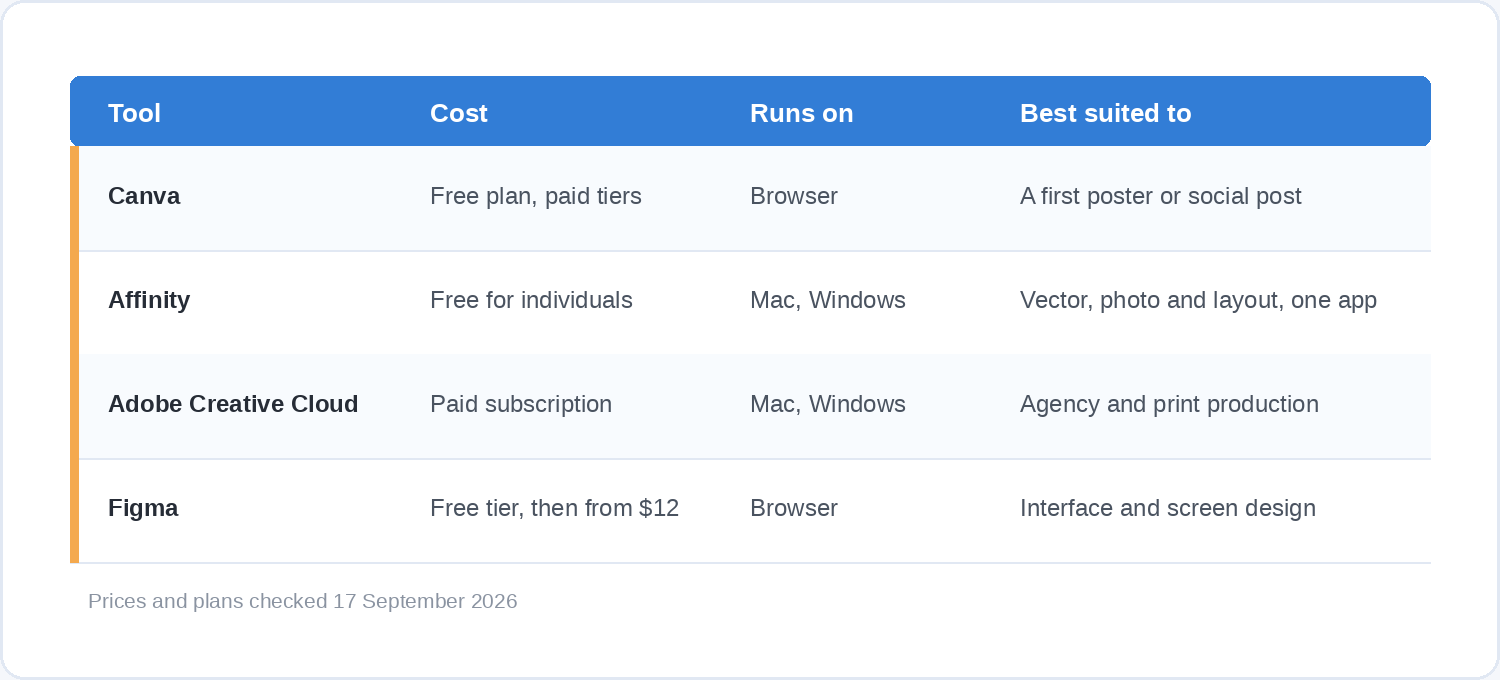
Canva runs in a browser, keeps a free plan with drag-and-drop editing, templates and 5 GB of storage, and is where most people who are not designers make their first poster. If you have never opened design software at all, our walkthrough of what Canva is and how it works is a reasonable place to start before you pick anything heavier.
Affinity was relaunched by Canva in October 2025 as a single application combining vector, pixel and layout work, and it is free for individuals on Mac and Windows. That matters, because until recently professional-grade vector and layout tools meant a subscription.
Adobe Creative Cloud remains the industry default in agencies and print production, built around Photoshop for images, Illustrator for vector work and InDesign for layout. It is a paid subscription, and most job adverts still name those three.
Figma is the standard for interface design and is used for a lot of general layout work too. Its free plan covers three projects and two members, with paid tiers from $12 per user per month billed annually.
You do not need all of them. Pick one, learn it properly, and add a second only when a job actually demands it.
Is graphic design a good career now?
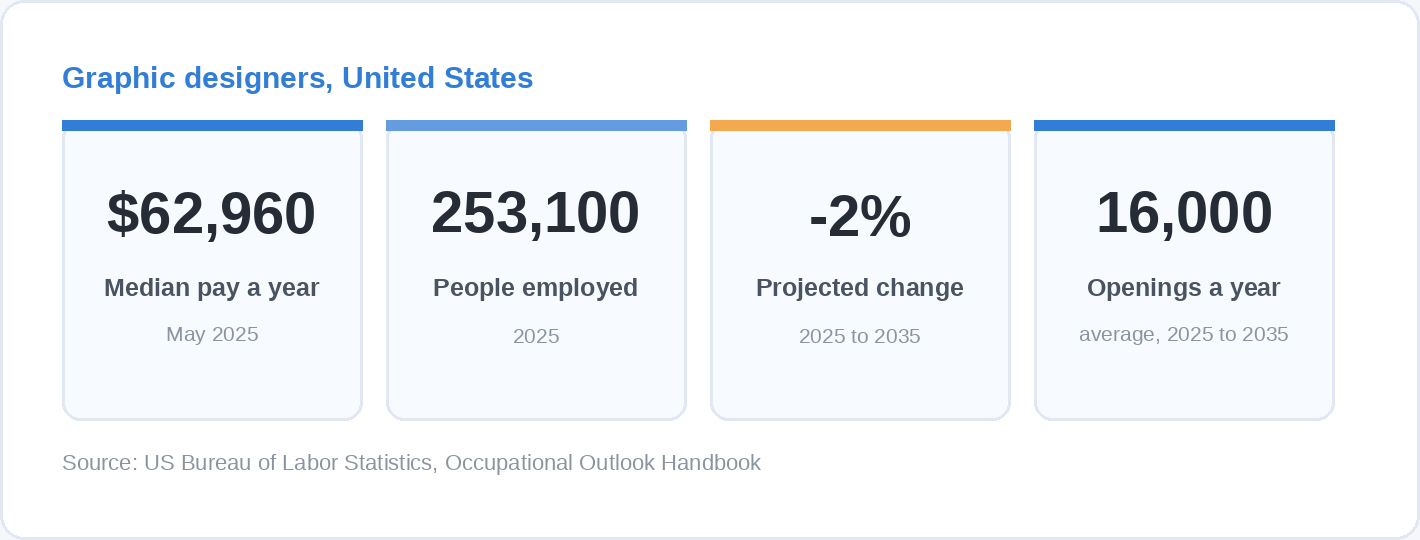
The most detailed public figures come from the United States, so treat them as a signal rather than as your local market. The US Bureau of Labor Statistics puts median pay for graphic designers at $62,960 a year as of May 2025, with 253,100 people employed in the occupation, and projects employment to decline by about 2 percent between 2025 and 2035. The same projection expects roughly 16,000 openings a year over that decade, almost all of them replacing people who retire or move into other work. A fifth of graphic designers are self-employed, and a bachelor’s degree is the typical entry-level qualification.
The BLS gives a specific reason for the decline: automated design tools, including AI, are expected to make designers more productive and reduce how many are needed, while organisations expanding their digital presence keep pulling in the other direction.
Read together, those numbers describe a field that is not growing in headcount but is still turning over sixteen thousand roles a year, and one where the routine production end is under real pressure. The work that survives that pressure is the part this article opened with. Deciding what a reader should notice first is a judgement about people, and it is the same judgement whether you execute it by hand, in InDesign, or by directing a tool that generates twelve options in a second.
How do you start learning graphic design?
Start with a real brief rather than a blank canvas. Redesign something that already exists and annoys you: a local menu, a village hall notice, the instructions that came with a piece of furniture. You will have actual content to organise and an actual failure to fix, which teaches faster than an exercise with lorem ipsum in it.
Learn one tool well enough to stop fighting it, then put the tool down and study type. Typography carries more of the load in real design work than any other skill, and it is the thing self-taught designers most often skip. Set the same page of text six different ways and look at what changed.
Get feedback from someone who is not being kind to you. Show the work at the size and distance it will really be seen at, print it if it is going to be printed, and check it on a phone if it is going to be scrolled. Then space the practice out over weeks instead of cramming it, because spacing your practice is one of the few study techniques with strong evidence behind it.
Expect the first six months to produce work you will later dislike. That is what a portfolio is for, and the only way past it is volume.
Common questions about graphic design
Do you need a degree to be a graphic designer?
No. A degree is the typical entry route in the US figures above, and some employers still filter on it, but hiring in this field is done on portfolios. What you show has more weight than what you studied.
Is graphic design the same as art?
They share techniques and they are both visual, but design answers to a brief and is measured against whether it achieved something for somebody else. Art carries no such obligation.
Is graphic design the same as UX design?
The two overlap without being the same. Graphic design arranges what a person sees, while user experience design shapes what a person does across a whole journey, including research, flows and testing. Many people do both, and the two roles are usually advertised separately.
How long does it take to get reasonably good?
Most people can produce competent, useful work within six to twelve months of regular practice, meaning a few hours a week on real briefs. Building the judgement that lets you get there quickly takes years, which is true of every craft.
Can you learn graphic design for free?
Yes, in the sense that the software no longer costs anything. Affinity is free for individuals, Canva has a permanent free plan, and Figma’s free tier covers small projects. What free tools do not give you is a structured path or anyone telling you why a layout is not working.
What is the first thing to learn?
Hierarchy. If you can decide what a reader should notice first, second and third, and then use scale, spacing and alignment to enforce it, you are already doing the job.
Design is one of those skills where an hour of the right instruction saves a fortnight of guessing, so if you would rather not guess, start with the free courses on Soofos, create an account that stays free, and see whether the work suits you before you spend anything on it.