

Behaviourism, cognitivism and constructivism turn up in every explanation of how people learn, and they are almost always presented as three camps you have to pick between. That framing is why most articles about them help nobody who is actually trying to learn something. Read as stages rather than as camps, they are far more useful: each one describes a different point in getting good at a subject, and there is a body of research that tells you roughly when to move from one to the next.
This is not an academic distinction if you take online courses. The three theories produce completely different study behaviour. One says copy the model answer closely. One says work out why it is the model answer. One says put the model answer away and try the thing yourself. Doing those in the wrong order is how people lose months to courses they finish and cannot use.
What are the three main learning theories?
Behaviourism treats learning as a change in observable behaviour, shaped by what happens immediately after that behaviour: practice, feedback, repetition. Cognitivism treats learning as information processing, and concerns itself with the limits of attention and memory that decide how much of a lesson survives contact with the learner. Constructivism treats learning as something the learner assembles, by connecting new material to what they already know and reorganising both in the process.
Each came out of a real research programme, and each was partly a reaction to the one before it. Behaviourism dominated the first half of the twentieth century, when psychology wanted to study only what it could observe from the outside. Cognitivism grew from the 1950s onwards as researchers got tools for describing what happens between a stimulus and a response. Constructivism drew on Jean Piaget’s work on how children build and revise their mental models, and on Lev Vygotsky’s work on how much of that building is social.
What is behaviourism, and where is it still right?
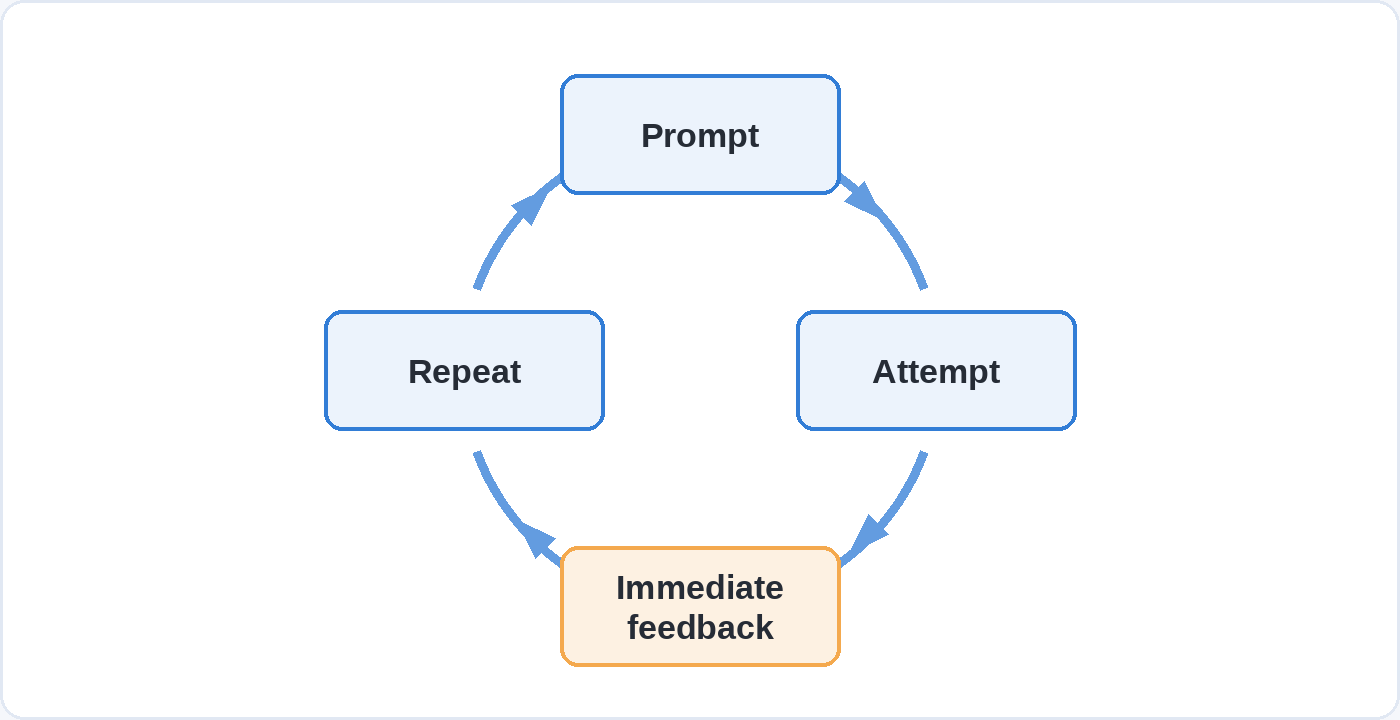
Behaviourism is right about the mechanics of practice: small steps, an attempt at every step, and feedback that arrives immediately rather than next week.
The clearest statement of that came from B. F. Skinner, who described the teaching machines he had built in Science in 1958. The design rule was that “each step must be so small that it can always be taken, yet in taking it the student moves somewhat closer to fully competent behavior”. His objection to ordinary classroom teaching was largely about timing. An examination “corrected and returned after a delay of many hours or days”, he wrote, leaves the student’s behaviour not appreciably modified, whereas an immediate report of whether you got it right can change what you do next. He also wanted the pace set by the learner rather than the room, on the grounds that a teacher is always moving too slowly for some students and too quickly for others.
Nearly every quiz in every online course descends from that design, as does every flashcard app, every code exercise that goes green or red, and every language streak. The parts of learning where this is still the best available advice are the parts where the goal is a fast, accurate, automatic response: vocabulary, formulas, keyboard shortcuts, chord shapes, the terminology of a new field. You want those retrieved without thinking, and repetition with immediate correction is how they get there.
What behaviourism does not give you is understanding. It describes the conditions that make a correct response more likely, and stays silent on what is happening inside the learner while that happens, which is the gap the next theory set out to describe.
What is cognitivism, and why does working memory decide so much?
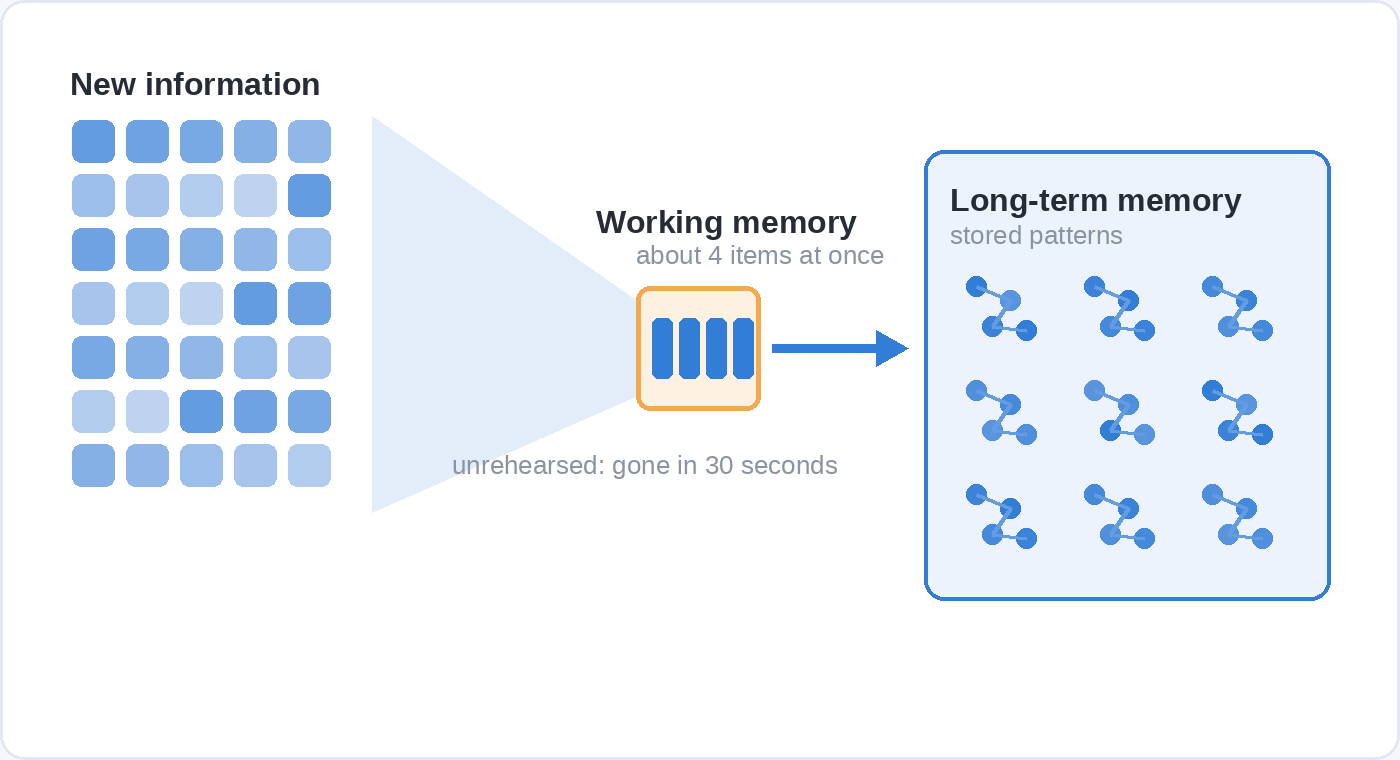
Cognitivism explains why a well-made lesson can still fail: new information has to pass through working memory, which holds very little and holds it briefly.
George Miller’s 1956 paper put the number of items at about seven, and later work revised it downward to around four. Paul Kirschner, John Sweller and Richard Clark, reviewing the evidence in Educational Psychologist in 2006, add a sharper point: when you are processing information rather than merely holding it, the number of items you can juggle may be closer to two or three. Almost anything in working memory that is not rehearsed is gone within thirty seconds.
Long-term memory is the other half of the picture, and the same authors call it “the central, dominant structure of human cognition”. The classic demonstration comes from chess. Adriaan de Groot, and later William Chase and Herbert Simon, found that master players reproduce a realistic board position far more accurately than weaker players, and that the advantage largely disappears when the pieces are scattered at random. Their advantage comes from thousands of stored patterns, which let a single glance carry information a beginner has to hold piece by piece.
That combination, a narrow working memory feeding a vast long-term store, is what makes worked examples so effective for beginners. Sweller and Cooper demonstrated the effect in 1985, and it has been replicated many times since: learners who study fully worked solutions tend to do better on later test problems than learners who were sent off to solve the same problems themselves. Kirschner and his co-authors put it plainly: for novices, studying worked examples seems invariably superior to discovering or constructing a solution. Solving a problem you do not yet understand spends your two or three available slots on searching for an answer, which leaves nothing for noticing how the answer works.
What is constructivism, and what does the evidence actually say?
Constructivism is well supported as a description of what understanding is, and much more contested as a recipe for how to teach.
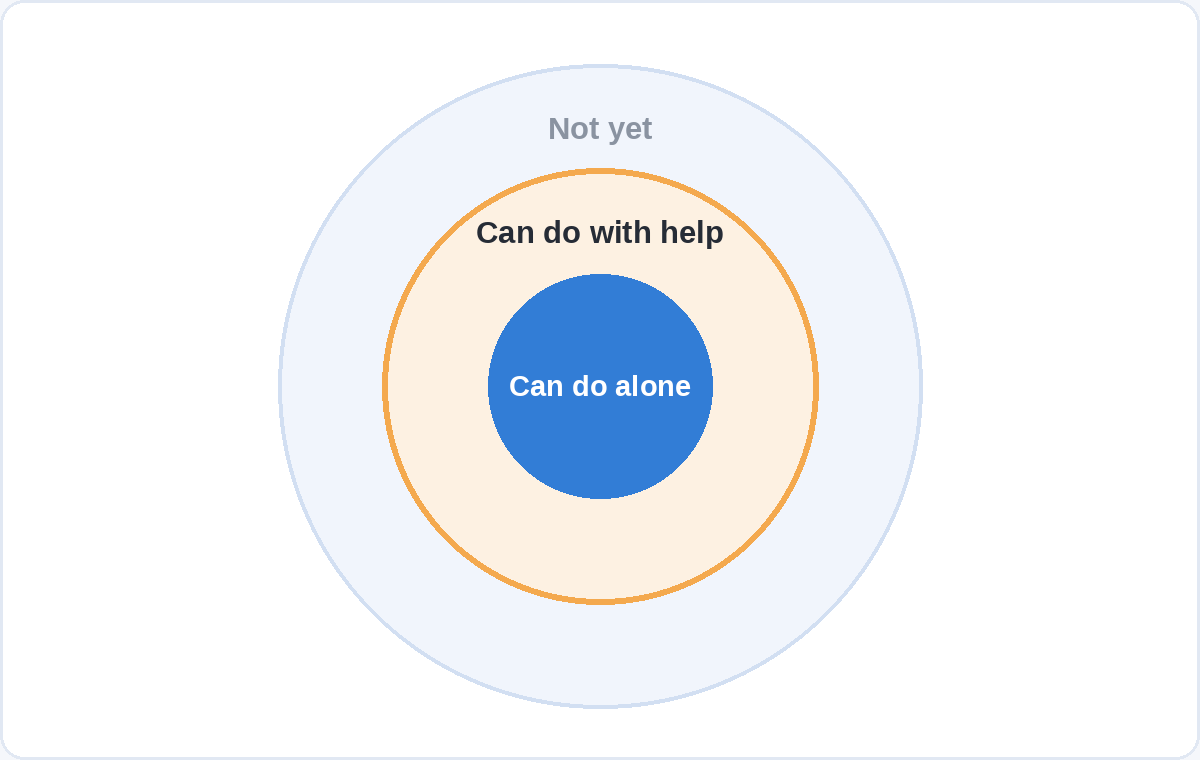
The descriptive half is not really in dispute. Piaget’s account has learners holding mental models, fitting new experience into them where it fits and reorganising them where it does not. Vygotsky added that much of this happens with other people, and named the zone of proximal development: the gap between what you can do on your own and what you can do with help from someone who already knows. The word “scaffolding” that usually follows in the same breath was not his. David Wood, Jerome Bruner and Gail Ross coined it later, applying Vygotsky’s idea to teaching.
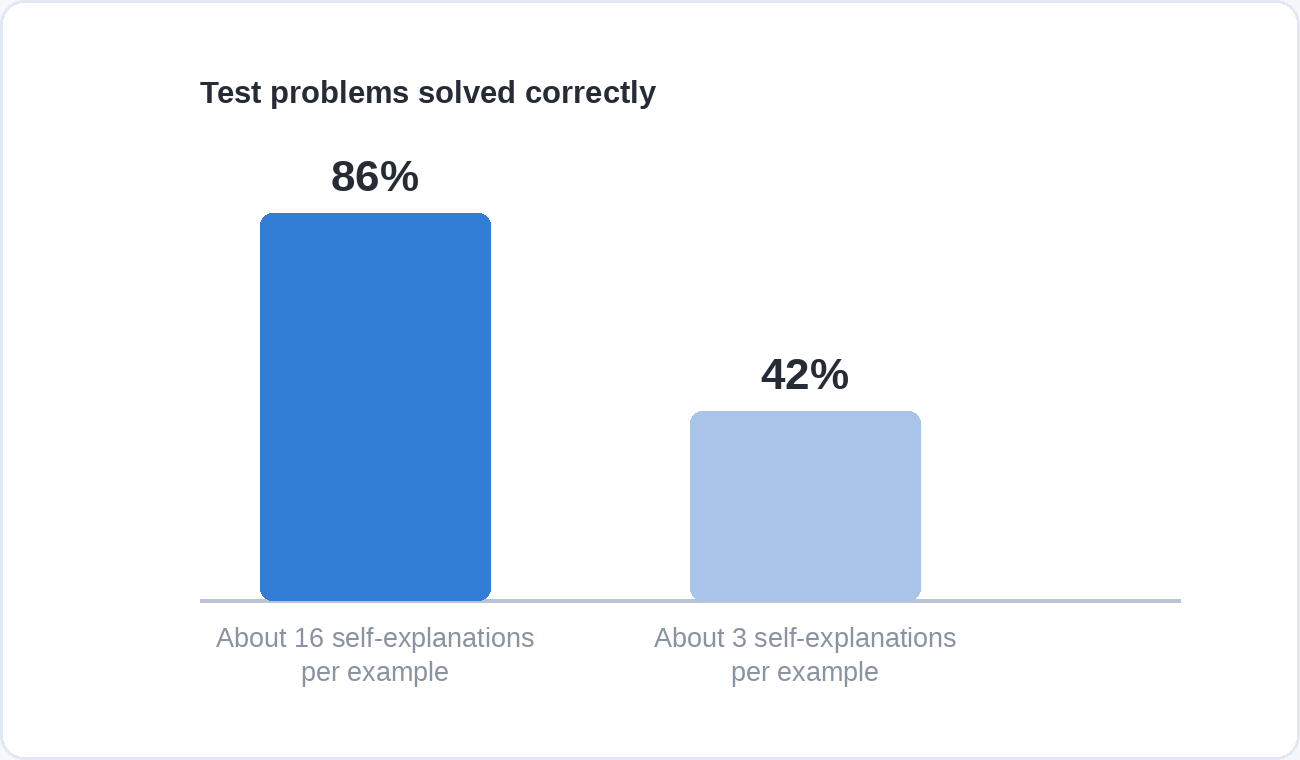
There is good evidence that the building work is what produces understanding. Michelene Chi’s 1989 study of students learning physics from worked examples found enormous variation in how much they explained the examples to themselves while reading. Students who generated around sixteen self-explanations per example went on to solve 86% of test problems correctly. Students who generated around three solved 42%. Same material, same time in front of it, and a gap of forty-four percentage points that came down to how actively they interrogated what they were reading.
The contested half is what happens when constructivism becomes a teaching method and learners are given a problem and very little guidance. Kirschner, Sweller and Clark’s review argues that this confuses two different things, and their formulation is worth keeping: the way an expert works in a domain is not the way a person learns that domain. Professional scientists investigate, so science lessons should be investigations; professional designers solve open briefs, so design courses should start with open briefs. It sounds right and it tends not to survive contact with a beginner, because the beginner does not yet have the stored patterns that make an open problem tractable.
Which learning theory should you use?
Use the one that matches how much you already know, because a technique that helps a beginner can actively hold back someone with experience.
That reversal has a name and a literature. Slava Kalyuga, Paul Ayres, Paul Chandler and John Sweller called it the expertise reversal effect in Educational Psychologist in 2003, and defined it as instructional techniques that are highly effective with inexperienced learners losing their effectiveness, and even having negative consequences, when used with more experienced learners. In one of their studies, mechanical trade apprentices with little experience learned most from studying worked examples. As their experience grew, the advantage of worked examples disappeared, and eventually solving problems themselves was the better use of their time. An earlier study with electrical trainees found the same shape: beginners did better with explanatory text integrated into the circuit diagrams, while more experienced trainees did better with the diagram on its own, the explanations having become something to read past.
The practical conclusion the authors draw is that instruction should be tailored to the experience level of the learner, and that without that tailoring its effectiveness is close to random. For a self-directed learner, that is unusually actionable, because you are the one choosing what to do next.
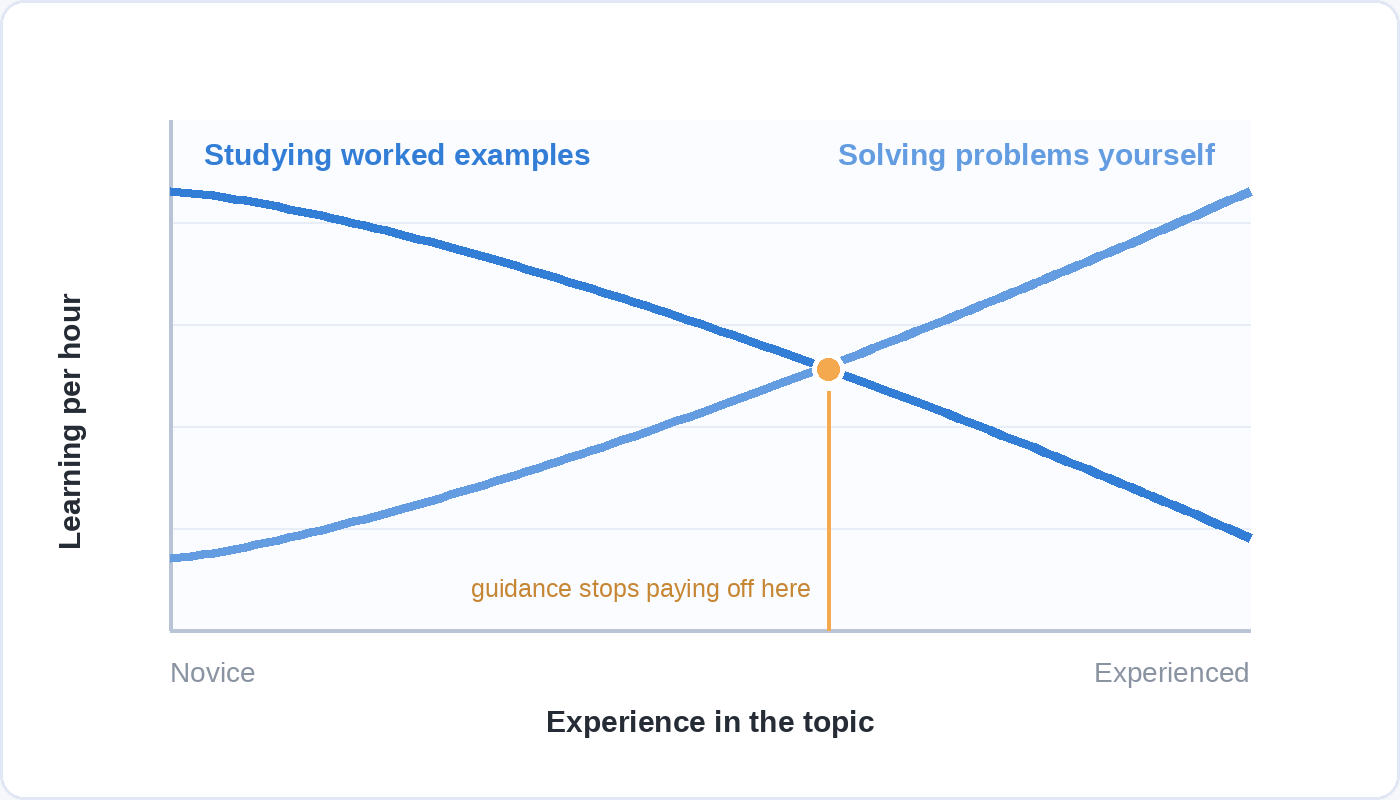
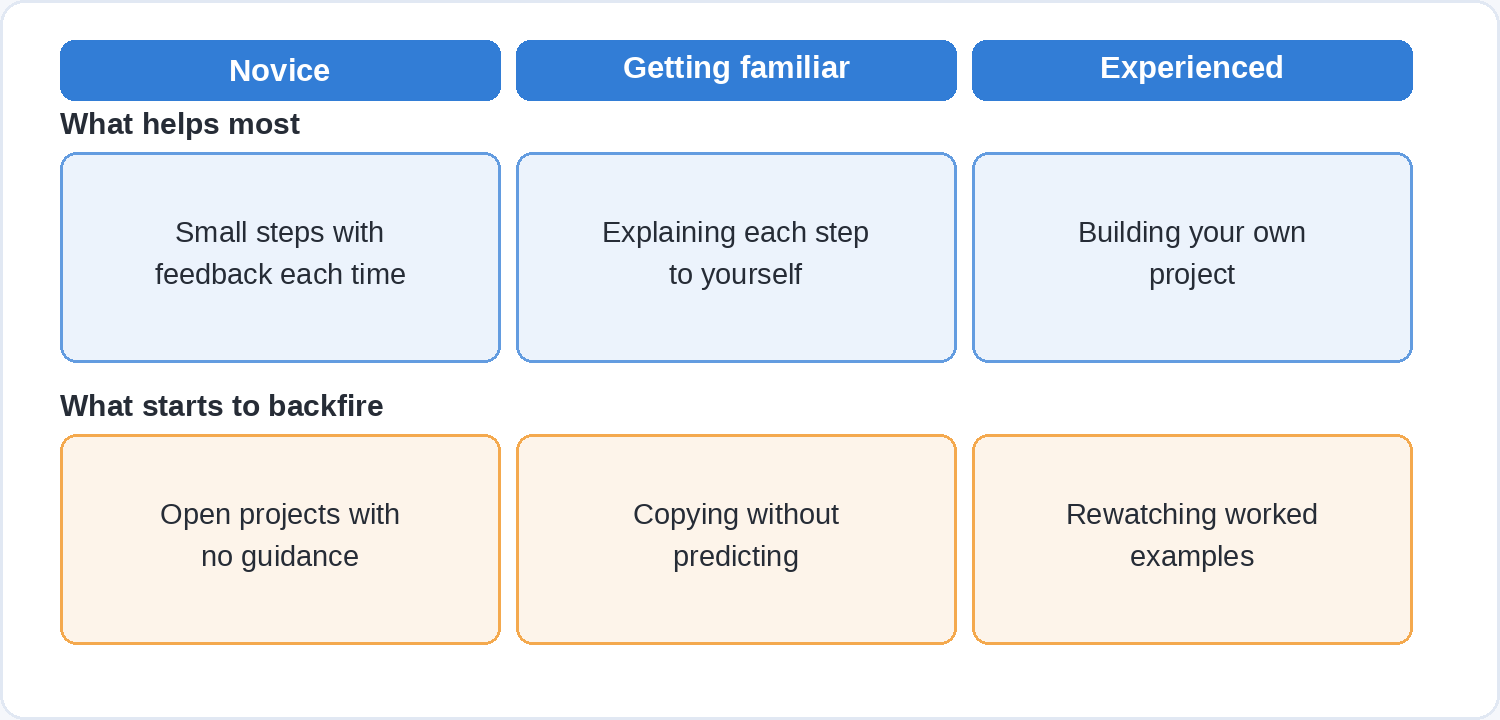
Roughly, the sequence runs like this. When the material is new, take it in small pieces with feedback at every piece, and study worked examples rather than fighting through problems. Once the basic moves are familiar, shift your effort to explaining the examples to yourself before you look at the solution, which is where the largest single gain in the Chi study came from. Once you can predict the solution before you see it, worked examples start costing you more than they give, and the right move is to close them and build something of your own.
What does this look like in a real online course?
Mostly it changes what you do with the video lessons, and when you stop watching them.
In the first hour of a new subject, watch and copy. Follow the instructor’s example exactly, pause often, and do the small exercise before moving on, because the value at this stage is in the immediate correction rather than in the exploration. Resist the urge to jump ahead to the project you actually want to make, since that is the open problem your working memory cannot yet carry.
Once the vocabulary and the basic moves are familiar, change how you watch. Pause before the instructor does the next step and predict it, then compare. Say out loud why the step works, not just what it was. This is the self-explanation habit, and the difference between doing it and not doing it is the difference between the two groups in Chi’s study.
When you find yourself correctly predicting most steps, stop watching and start building. Take a real project, hit real problems, and go back to the course only for the specific thing you are stuck on. The same lessons that carried you through week one are now slowing you down, which is the expertise reversal effect arriving in your own evening. If you want the broader evidence on what makes study time pay, our piece on how to learn easier ranks ten common techniques by how much they actually return.
Common questions about learning theories
Are there only three learning theories?
No. Humanism, social learning theory and connectivism are all regularly included in longer lists. Behaviourism, cognitivism and constructivism are the three with the longest research record and the clearest practical implications for someone studying on their own.
Which learning theory is the best one?
None of them is best in general, because they answer different questions. Behaviourism describes the conditions for practice, cognitivism describes the memory limits any lesson has to respect, and constructivism describes how understanding is assembled. The useful question is which one fits your current level in a specific subject.
Is constructivism wrong, then?
As a description of how understanding forms, it has strong support, including the self-explanation research. What the evidence disputes is the teaching approach that gives beginners an open problem and little guidance, which tends to produce worse results than showing them worked examples first.
Do learning styles fit into this?
They are a separate idea with far weaker support. Harold Pashler and colleagues reviewed the evidence in Psychological Science in the Public Interest in 2008 and reported virtually no evidence for the interaction that matching lessons to a visual, auditory or kinaesthetic preference would have to produce, with several studies contradicting it outright. None of the three theories here predicts that such matching should work.
What is the single most useful thing to take from all this?
Match the method to your level, and change it as your level changes. Copy closely at the start, explain to yourself in the middle, and build on your own once you can predict what comes next.
Where to take this next
The quickest way to feel the difference is to try it on something you are already learning, and notice which of the three phases you are actually in. If you would like a subject to practise it on, the personal development courses on Soofos are built the way this article recommends: short video lessons you can copy step by step, assignments that make you explain your reasoning, and enough room to go and build something once the basics stop being the hard part.